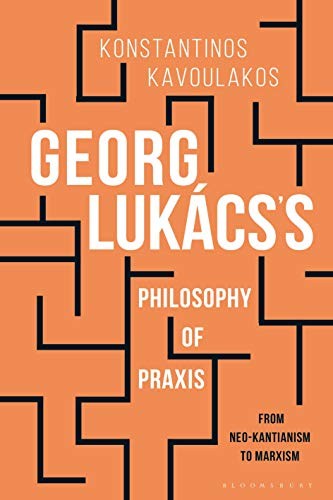
Georg Lukács's Philosophy of Praxis
0
0
As an Amazon Associate and affiliate partner, Menrva Books earns from qualifying purchases. Learn more
Author Description
Georg Lukc̀s' early Marxist philosophy of the 1920s laid the foundations of Critical Theory. However the evaluation of Lukc̀s' philosophical contribution has been largely determined by one-sided readings of eminent theorists like Adorno, Habermas, Honneth or even Luk ̀himself. This book offers a new reconstruction of Lukc̀s' early Marxist work, capable of restoring its dialectical complexity by highlighting its roots in his neo-Kantian, 'pre-Marxist' period. In his pre-Marxist work Luk ̀sought to articulate a critique of formalism from the standpoint of a dubious mystical ethics of revolutionary praxis. Consequently, Luk ̀discovered a more coherent and realistic answer to his philosophical dilemmas in Marxism. At the same time, he retained his neo-Kantian reservations about idealist dialectics. In his reading of historical materialism he combined non-idealist, non-systematic historical dialectics with an emphasis on conscious, collective, transformative praxis. Reformulated in this way Lukc̀s' classical argument plays a central role within a radical Critical Theory.--Bloomsbury Publishing.
Menrva's Summary
THE THESIS
This book re-examines Georg Lukács's early Marxist philosophy of the 1920s, a foundational element of Critical Theory, by offering a new reconstruction that restores its dialectical complexity. The work challenges one-sided interpretations by highlighting Lukács's roots in his neo-Kantian, 'pre-Marxist' period, where he sought to articulate a critique of formalism from a mystical ethics of revolutionary praxis. This led him to find a more coherent answer in Marxism, while retaining neo-Kantian reservations about idealist dialectics. The book argues that by combining non-idealist historical dialectics with an emphasis on conscious, collective, transformative praxis, Lukács's reformulated argument plays a central role within a radical Critical Theory.
THE SCOPE MAP
- A new reconstruction of Georg Lukács's early Marxist work from the 1920s.
- An analysis of the influence of Lukács's neo-Kantian, 'pre-Marxist' period on his later Marxist thought.
- A critique of formalism rooted in a 'mystical ethics of revolutionary praxis'.
- An examination of Lukács's synthesis of historical materialism with an emphasis on conscious, collective, transformative praxis.
- An argument for the central role of Lukács's reformulated ideas within radical Critical Theory.
THE AUTHORITY PERSPECTIVE
This book is presented as a significant re-evaluation of Georg Lukács's early Marxist philosophy, aiming to correct what the author perceives as one-sided readings by prominent theorists. The work's approach emphasizes restoring the dialectical complexity of Lukács's thought by tracing its origins in his pre-Marxist neo-Kantian period. By highlighting the interplay between his critique of formalism, his ethical considerations of revolutionary praxis, and his subsequent engagement with Marxism, the book seeks to establish a more coherent and realistic understanding of his philosophical contributions. The reformulated arguments are positioned to play a central role within a radical Critical Theory.
Page Count:
264
Publication Date:
2018-01-01
ISBN-10:
1474267416
ISBN-13:
9781474267410
Philosophy
Non-Fiction
Marxism
Critical Theory
Intellectual History
Political Philosophy
Community Tags
Similar Books