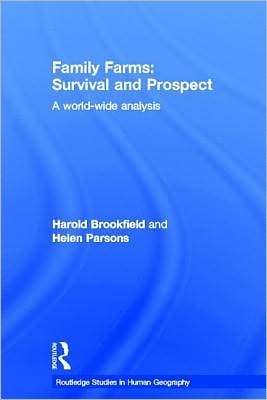
Family Farms: Survival and Prospect
0
0
As an Amazon Associate and affiliate partner, Menrva Books earns from qualifying purchases. Learn more
Author Description
Marx, Lenin and Kautsky all regarded family farming as doomed to be split into capitalist farms and proletarian labour. Most modern economists regard family farming as an archaic form of production organization, destined to give way to agribusiness. Family Farms refutes these notions and analyses the manner in which family farmers have been able to operate with success in both developed and developing countries, using examples wherever these are illuminating.This book begins by reviewing theoretical arguments about agricultural structures, and defines family farming. This is followed by five vignettes about farming in the first half of the twentieth century. The authors analyse the conditions of access to land and water, labour, livestock, tools and seed and review marketing arrangements and how they have changed since 1900. A three-chapter review of evolving policies in the North Atlantic countries, in the communist states, and in the developing countries, leads to a discussion of the impact of neo-liberalism. New issues of the farmer as steward of the environment are explored, as well as modern ideas about de-agrarianization and a discussion of land reform, tracing the experience of Mexico and Brazil. In two final chapters the more positive approach of pluriactivity is discussed and followed by a review of organic farming as a principal modern innovation. New political organizations representing family farming are described and their demands are discussed with empathy, but in a sceptical manner.Family farming is an adaptable and resilient form of production organization, and these qualities have allowed it to survive. The future will be no easier than the past, yet family farming continues to flourish in most contexts. This book will be useful for researchers, students and lecturers interested in Development Studies, Rural Studies and Geography and Anthropology, as well as general readers who have an interest in farming.
Menrva's Summary
THE THESIS
This book investigates the enduring viability of family farming as a production organization in the face of historical predictions of its obsolescence. Harold Brookfield and Helen Parsons, both established scholars in geography and development studies, utilize a comparative analysis of agricultural structures across developed and developing nations to challenge the Marxist and modern economic consensus that family farms are destined to be replaced by agribusiness. By synthesizing historical data from the twentieth century with contemporary policy analysis, the authors argue that family farming possesses inherent adaptability and resilience that allow it to persist in diverse global contexts.
THE SCOPE MAP
What You Will Find
- Comparative analysis of agricultural policies in North Atlantic countries, former communist states, and developing nations.
- Historical review of access to land, water, labor, and marketing arrangements since 1900.
- Examination of modern agricultural innovations including organic farming and pluriactivity.
- Evaluation of the impact of neo-liberalism, land reform, and environmental stewardship on small-scale producers.
THE AUTHORITY PERSPECTIVE
Experts and academics in the fields of rural studies and development economics recognize this work as a comprehensive defense of small-scale agricultural models. Readers frequently note the academic density of the prose, which provides a rigorous framework for understanding the socio-economic persistence of family-run operations.
Page Count:
250
Publication Date:
2007-01-01
Publisher:
Routledge
ISBN-10:
0203935977
ISBN-13:
9780203935972
Economics
Rural Studies
Anthropology
Agriculture
Geography
Community Tags
Similar Books