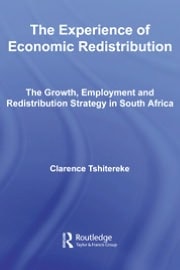
Experience of Economic Redistribution: The Growth, Employment and Redistribution Strategy in South Africa
0
0
As an Amazon Associate and affiliate partner, Menrva Books earns from qualifying purchases. Learn more
Author Description
This book provides an analysis of the country's political economy in transition. It documents the history of the gold mining industry's involvement in shaping the political landscape of South Africa, and shows the degree to which the political transition was induced to put in place a new mode of regulation for capital accumulation. In the process, the victims of apartheid have now become victims of democracy's neo-liberalism as the government is constrained from being developmental, interventionist and redistributive.
Menrva's Summary
THE THESIS
This book investigates the structural constraints and political economic outcomes of South Africa's Growth, Employment and Redistribution (GEAR) strategy during the post-apartheid transition. Clarence Tshitereke utilizes historical analysis and political economy frameworks to examine how the gold mining industry influenced the nation's regulatory environment. The author argues that the transition to a neo-liberal economic model has limited the state's capacity to implement developmental and redistributive policies, effectively shifting the burden of economic hardship onto the victims of the previous regime.
THE SCOPE MAP
What You Will Find
- Historical analysis of the gold mining industry's influence on South African political structures.
- Examination of the transition from apartheid-era governance to post-apartheid neo-liberalism.
- Critique of the Growth, Employment and Redistribution (GEAR) strategy and its impact on state interventionism.
- Assessment of the socio-economic challenges facing the post-apartheid democratic state.
THE AUTHORITY PERSPECTIVE
Scholars and political analysts frequently cite this work for its critical perspective on the limitations of South Africa's post-1994 economic policy. The text is recognized as a significant contribution to the study of neo-liberalism within developing nations and the specific political economy of the Southern African region.
Page Count:
224
Publication Date:
2006-01-01
Publisher:
Taylor & Francis Group
ISBN-10:
0203944291
ISBN-13:
9780203944295
Economics
Industrial Relations
Gold Mining
South Africa
Public Policy
Community Tags
Similar Books