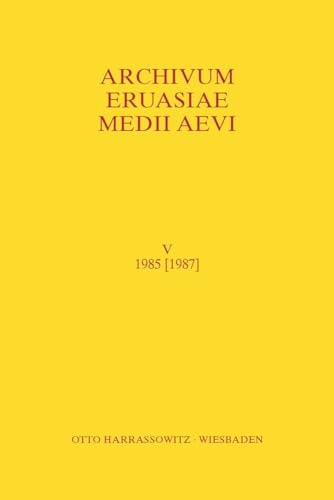
Archivum Eurasiae Medii Aevi V
0
0
As an Amazon Associate and affiliate partner, Menrva Books earns from qualifying purchases. Learn more
Author Description
The focus of Archivum Eurasiae Medii Aevi is on the political, social, economic and linguistic history of the peoples of the Eurasian steppes and adjoining regions from late antiquity to the Mongol Empire and its successor states. Among its primary concerns are questions regarding the Iranian steppe peoples, the Huns, the Oghur and Bulghar Turkic peoples, the Sabirs, the Avars, the Khazars and other peoples of the Turk Empire, the Hungarians, Pechenegs, Cumans and peoples of the Mongol Empire. The periodical will also touch on many points in the history of the Slavic world, Crimea, Byzantium, Iran, the Caucasus, the lands of Islam and the peoples of Central and Northern Europe, as well as elucidate various questions of Turkic and steppe history. From the contents: - Allsen, T.T.: The Princes of the Left Hand: An Introduction to the History of the Ulus of Orda in the Thirteenth and Early Fourteenth Centuries - Golden, P.B.: The Byzantine Greek Elements in the Rasulid Hexaglot - Noonan, Th. S.: Khazaria as an Intermediary Between Islam and Eastern Europe in the Second Half on the Ninth Century: The Numismatic Perspective - Vasary, I.: The Linguistic Aspect of the "Bashkiro-Hungarian Complex"
Menrva's Summary
THE THESIS
This volume of Archivum Eurasiae Medii Aevi investigates the political, social, economic, and linguistic history of Eurasian steppe peoples from late antiquity to the successor states of the Mongol Empire. The journal's scope encompasses the Iranian steppe peoples, Huns, Oghur and Bulghar Turkic peoples, Sabirs, Avars, Khazars, and other Turkic peoples, as well as Hungarians, Pechenegs, Cumans, and peoples of the Mongol Empire, touching upon the Slavic world, Crimea, Byzantium, Iran, the Caucasus, the Islamic world, and Central and Northern Europe.
THE SCOPE MAP
- An examination of the Ulus of Orda in the Thirteenth and Early Fourteenth Centuries by T.T. Allsen.
- An analysis of Byzantine Greek elements within the Rasulid Hexaglot by P.B. Golden.
- A numismatic perspective on Khazaria's role as an intermediary between Islam and Eastern Europe in the latter half of the ninth century by Th.S. Noonan.
- An exploration of the linguistic aspects of the 'Bashkiro-Hungarian Complex' by I. Vasary.
THE AUTHORITY PERSPECTIVE
This volume of Archivum Eurasiae Medii Aevi presents scholarly articles focusing on the historical and linguistic interactions of various peoples across Eurasia during the medieval period. The contributions delve into specific regions and ethnic groups, offering detailed analyses supported by historical and linguistic evidence. The collection aims to illuminate the complex relationships between steppe societies and their settled neighbors, contributing to a deeper understanding of Eurasian history. The articles suggest a rigorous academic approach to the study of these historical dynamics.
Page Count:
232
Publication Date:
1987-12-31
Publisher:
Harrassowitz Verlag
ISBN-10:
3447086106
ISBN-13:
9783447086103
History
Non-Fiction
Linguistics
Turkic Peoples
Eurasian History
Mongol Empire
Community Tags
Similar Books