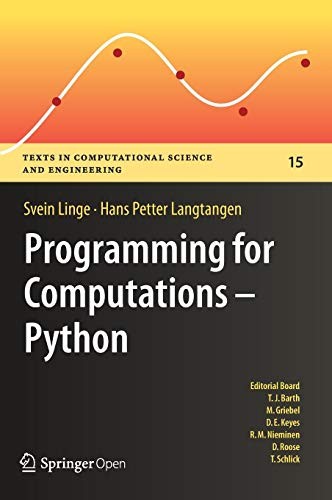
Programming for Computations - Python: A Gentle Introduction to Numerical Simulations with Python
0
0
As an Amazon Associate and affiliate partner, Menrva Books earns from qualifying purchases. Learn more
Author Description
Programming for Computations - Python: A Gentle Introduction to Numerical Simulations with Python is designed as a textbook for introductory programming courses in science and engineering that emphasize computation and numerical methods. The book is written for students and researchers who need to develop computational skills for scientific and engineering applications, and who have little or no prior experience with programming. The book is structured as a gentle introduction to programming with Python and numerical simulations. It is designed to be used in a classroom setting, but it can also be used for self-study. The book is divided into three parts. Part I introduces the basic concepts of programming with Python. Part II introduces the basic concepts of numerical simulations. Part III introduces the basic concepts of scientific and engineering applications. The book is written in a clear and concise style, and it is illustrated with numerous examples and figures. The book is also available as an e-book.
Menrva's Summary
THE THESIS
This book introduces the fundamental principles of numerical simulations using the Python programming language. It is designed for students and researchers who need to develop computational skills for scientific and engineering applications, focusing on practical implementation rather than theoretical depth. The text guides readers through the process of translating mathematical models into executable Python code, emphasizing clarity and accessibility for those new to the field.
THE SCOPE MAP
- Introduction to Python for scientific computing
- Core concepts of numerical methods
- Implementation of algorithms for simulations
- Examples and case studies in various scientific domains
- Focus on data visualization and analysis
- Building blocks for more advanced computational tasks
- Practical exercises and code examples
THE AUTHORITY PERSPECTIVE
The book is structured as an accessible introduction to computational science and engineering, leveraging Python's capabilities for numerical simulations. Its approach suggests a focus on practical application and learning by doing, likely appealing to students and early-career professionals seeking to build foundational skills in this interdisciplinary field. The emphasis on Python indicates a modern, widely-used toolset for scientific problem-solving. The content is expected to cover essential numerical techniques and their implementation, providing a solid basis for further study.
Page Count:
232
Publication Date:
2016-01-01
ISBN-10:
3319324276
ISBN-13:
9783319324272
Science
Non-Fiction
Numerical Methods
Engineering
Programming
Python
Scientific Computing
Community Tags
Similar Books