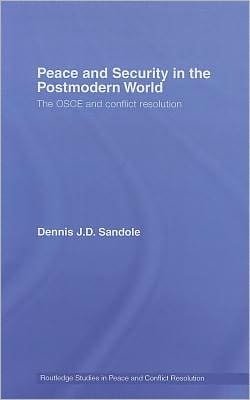
Peace and Security in the Postmodern World: The OSCE and Conflict Resolution
0
0
As an Amazon Associate and affiliate partner, Menrva Books earns from qualifying purchases. Learn more
Author Description
Comprising Interviews Conducted With Senior Csce/osce Negotiators About Recent Tumultuous Events In Global Affairs And Insights From The Conflict Resolution Literature, This Book Analyses How Postmodern Conflict Such As The Recent Balkan Wars And The Post-9/11 New Terrorism Can Be Prevented And/or Otherwise Dealt With In The Future.--jacket. Preface Acknowledgements Glossary Foreword Alice Ackermann, Osce Conflict Prevention Centre 1. Violent Postmodern Conflict: A Need To Go Beyond Symptoms 2. A Framework For Analyzing Violent Postmodern Conflict 3. A Model For Responding To Violent Postmodern Conflict 4. Eliciting The Wisdom Of Csce/osce Negotiators: Research Design 5. Csce/osce Negotiators' Perceptions Of Select Peace And Security Issues 6. Csce/osce Negotiators' Perceptions Of Causes Of The Balkan Wars Of The 1990s 7. Csce/osce Negotiators' Perceptions Of Lessons Learned From The Balkan Wars Of The 1990s 8. Csce/osce Negotiators' Visions Of Ideal Peace And Security In Postmodern Europe 9. After 9/11: Peace And Security Issues Revisited 10. Implications For Research, Theory, And Policy Appendix A Appendix B Bibliography Index. Dennis J.d. Sandole. Includes Bibliographical References (p. [218]-246) And Index.
Menrva's Summary
THE THESIS
This book investigates how international organizations, specifically the OSCE, can effectively prevent and manage violent conflicts in a complex, postmodern global landscape. Dennis J. D. Sandole, a scholar in conflict analysis and resolution, synthesizes academic theory with empirical data derived from interviews with senior OSCE negotiators. The text presents a structured framework for understanding the unique challenges posed by modern threats, such as ethnic warfare and transnational terrorism, while proposing models for more robust diplomatic intervention.
THE SCOPE MAP
What You Will Find
- Analysis of the Balkan Wars of the 1990s as a case study for postmodern conflict.
- A theoretical framework for analyzing and responding to violent, non-traditional security threats.
- Qualitative data gathered from primary source interviews with senior CSCE/OSCE negotiators.
- Strategic implications for future research, international policy, and peace-building theory.
THE AUTHORITY PERSPECTIVE
Experts recognize this work as a significant contribution to the study of regional security organizations and their practical application in conflict zones. Readers frequently note the academic density of the prose, which serves as a foundational text for students and practitioners interested in the evolution of European security architecture.
Page Count:
260
Publication Date:
2006-01-01
Publisher:
Routledge
ISBN-10:
0203966449
ISBN-13:
9780203966440
History
International relations
Peace
Organization for Security and Co-operation in Europe
Conflict Resolution
Security Studies