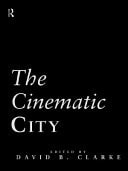
The Cinematic City
0
0
As an Amazon Associate and affiliate partner, Menrva Books earns from qualifying purchases. Learn more
Author Description
The Cinematic City Offers An Innovative And Thought-provoking Insight Into Cityscape And Screenscape And Their Inter-connection. Illustrated Throughout With Movie Stills, A Diverse Selection Of Films (from 'bladerunner' To 'little Caesar'), Genres, Cities And Historical Periods Are Examined By Leading Names In The Field. The Key Dimensions Of Film And Urban Theory Are Introduced Before Detailed Analysis Of The Various Cinematic Forms Which Relate Most Significantly To The City. From Early Cinema And Documentary Film, To Film Noir, 'new Wave' And 'postmodern Cinema', The Contributors Provide A Wealth Of Empirical Material And Illustration Whilst Drawing On The Theoretical Insights Of Contemporary Feminism, Benjamin, Baudrillard, Foucault, Lacan, And Others. The Cinematic City Shows How The City Has Been Undeniably Shaped By The Cinematic Form, And How Cinema Owes Much Of Its Nature To The Historical Development Of Urban Space. Engaging With Current Theoretical Debates, This Is A Book That Is Set To Change The Way In Which We Think About Both The Nature Of The City And Film. Contributors: Giuliana Bruno, Iain Chambers, Marcus Doel, David Clarke, Anthony Easthope, Elisabeth Mahoney, Will Straw, Stephen Ward, John Gold, James Hay, Rob Lapsley, Frank Krutnik
Menrva's Summary
THE THESIS
This book investigates the reciprocal relationship between urban environments and cinematic representation, questioning how the city shapes film and how film, in turn, constructs our understanding of urban space. Editor David B. Clarke compiles a series of essays from prominent scholars in geography, film studies, and cultural theory. The text utilizes a multidisciplinary framework, drawing on the works of Benjamin, Baudrillard, Foucault, and Lacan to analyze the intersection of physical cityscapes and projected screenscapes. By examining diverse historical periods and film genres, the contributors argue that the city and cinema are mutually constitutive entities.
THE SCOPE MAP
What You Will Find
- Analysis of cinematic movements including Film Noir, New Wave, and Postmodern Cinema.
- Theoretical application of contemporary feminism, psychoanalysis, and urban theory to film criticism.
- Empirical case studies ranging from early documentary film to science fiction classics like Blade Runner.
- Examination of the historical development of urban space in relation to the evolution of film technology.
THE AUTHORITY PERSPECTIVE
Experts recognize this volume as a foundational interdisciplinary text that bridges the gap between urban geography and film theory. Readers frequently note the academic density of the prose, which requires a familiarity with continental philosophy and critical theory to fully grasp the arguments presented.
Page Count:
264
Publication Date:
2005-01-01
Publisher:
Taylor & Francis Group
ISBN-10:
0203973364
ISBN-13:
9780203973363
Architecture
Urban Studies
In art
Sociology
Film Studies
Motion pictures
Cultural Theory
Community Tags
Similar Books