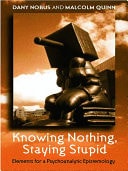
Knowing Nothing, Staying Stupid
0
0
As an Amazon Associate and affiliate partner, Menrva Books earns from qualifying purchases. Learn more
Author Description
Why Is Stupidity Sublime? What Is The Value Of A 'dialectics Of Ignorance' For Analysts And Academics? Knowing Nothing, Staying Stupid Draws On Recent Research To Provide A Thorough And Illuminating Evaluation Of The Status Of Knowledge And Truth In Psychoanalysis. Adopting A Lacanian Framework, Dany Nobus And Malcolm Quinn Question The Basic Assumption That Knowledge Is Universally Good And Describe How Psychoanalysis Is In A Position To Place Forms Of Knowledge In A Dialectical Relationship With Non-knowledge, Blindness, Ignorance And Stupidity. The Book Draws Out The Implications Of A Psychoanalytic Theory Of Knowledge For The Practices Of Knowledge Construction, Acquisition And Transmission Across The Humanities And Social Sciences. The Book Is Divided Into Two Sections. The First Section Addresses The Foundations Of A Psychoanalytic Approach To Knowledge As It Emerges From Clinical Practice, Whilst The Second Section Considers The Problems And Issues Of Applied Psychoanalysis, And The Ambiguous Position Of The Analyst In The Public Sphere. Subjects Covered Include: The Logic Of Psychoanalytic Discovery Creative Knowledge Production And Institutionalised Doctrine The Desire To Know Versus The Fall Of Knowledge Epistemological Regression And The Problem Of Applied Psychoanalysis This Provocative Discussion Of The Dialectics Of Knowing And Not Knowing Will Be Welcomed By Practicing Psychoanalysts And Students Of Psychoanalytic Studies, But Also By Everyone Working In The Fields Of Social Science, Philosophy And Cultural Studies.
Menrva's Summary
THE THESIS
This book investigates the paradoxical value of ignorance and stupidity within the framework of psychoanalytic theory and academic knowledge production. Authors Dany Nobus and Malcolm Quinn utilize a Lacanian lens to challenge the conventional assumption that the accumulation of knowledge is inherently beneficial. By examining the dialectical relationship between knowledge and non-knowledge, the authors argue that psychoanalysis offers a unique methodology for navigating the limitations of human understanding and the institutionalization of truth.
THE SCOPE MAP
What You Will Find
- A foundational analysis of psychoanalytic discovery and its relationship to clinical practice.
- A critical examination of the tension between the desire to know and the systemic fall of knowledge.
- Theoretical discussions regarding epistemological regression and the challenges of applied psychoanalysis.
- An evaluation of the analyst's ambiguous role within the public sphere and institutionalized doctrine.
THE AUTHORITY PERSPECTIVE
Experts within the fields of philosophy and psychoanalytic studies identify this work as a rigorous exploration of Lacanian theory applied to contemporary academic structures. Readers frequently note the high level of intellectual density in the prose, making it a specialized resource for practitioners and scholars interested in the intersection of ignorance and knowledge production.
Page Count:
264
Publication Date:
2005-01-01
Publisher:
Routledge
ISBN-10:
020397025X
ISBN-13:
9780203970256
Philosophy
Social Science
Epistemology
Psychoanalysis
Community Tags
Similar Books