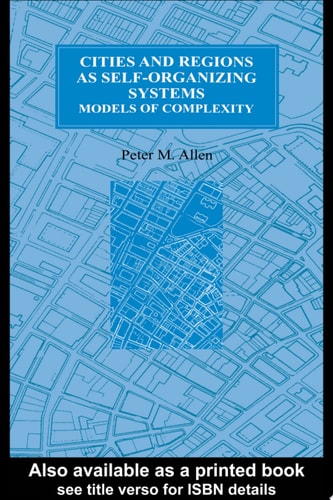
Cities and Regions as Self-Organizing Systems
0
0
As an Amazon Associate and affiliate partner, Menrva Books earns from qualifying purchases. Learn more
Author Description
No description available.
Menrva's Summary
THE THESIS
This work investigates how urban environments and regional structures emerge and evolve through the principles of self-organization and non-linear dynamics. Peter M. Allen, a researcher in complex systems, utilizes mathematical modeling and evolutionary theory to explain how individual human decisions aggregate into large-scale spatial patterns. The book argues that cities are not static entities but dynamic systems that respond to internal fluctuations and external environmental pressures, requiring a shift from traditional equilibrium-based planning models to those that embrace instability and change.
THE SCOPE MAP
What You Will Find
- Mathematical models of urban growth and spatial distribution
- Application of dissipative structures and non-equilibrium thermodynamics to human geography
- Analysis of regional economic development and population migration patterns
- Methodologies for simulating long-term urban evolution and structural transformation
THE AUTHORITY PERSPECTIVE
Experts in urban geography and complexity science recognize this text as a foundational contribution to the application of systems theory in spatial planning. Readers frequently note the high level of mathematical and theoretical density, making it a specialized resource for academics and researchers in the field.
Page Count:
0
Publication Date:
1998-01-01
Publisher:
Taylor & Francis, Inc.
ISBN-10:
0203990013
ISBN-13:
9780203990018
Complexity Science
Sociology
Geography
Systems Theory
urban planning