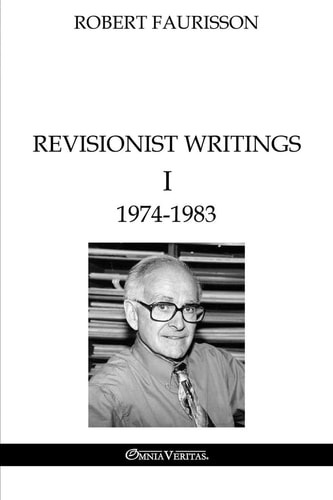
Revisionist Writings I - 1974-1983
0
0
As an Amazon Associate and affiliate partner, Menrva Books earns from qualifying purchases. Learn more
Author Description
Revisionism is a matter of method, not ideology. It advocates, for all research, a return to the starting point, examination followed by re-examination, re-reading and re-writing, evaluation followed by re-evaluation, reorientation, revision, recasting; it is, in spirit, the opposite of ideology. It does not deny, but aims to affirm more accurately. Revisionists are not 'deniers' or 'negationists'; they strive to seek and find where, it seems, there was nothing left to seek or find. Revisionism can be applied to a hundred everyday activities and a hundred areas of historical, scientific or literary research. It does not necessarily call into question established ideas, but often leads to their being qualified. It seeks to disentangle the true from the false. History is, by its very nature, revisionist; ideology is its enemy. As ideology is never stronger than in times of war or conflict, and as it then manufactures falsehoods in profusion for the needs of its propaganda, the historian will, in the circumstances, be led to redouble his vigilance: He will no doubt realise that, where a war has caused tens of millions of victims, the first victim will have been the verifiable truth: a truth that must be sought out and re-established. The official history of the Second World War contains a little truth combined with a lot of falsehood. At the risk of being misunderstood by some, I dedicate this book to those, among the bloody victors of the Second World War, who, like Churchill, Eisenhower or de Gaulle, refused, both during the battle and afterwards, to endorse, if only with one word, the atrocious, grotesque, insolent imposture of the alleged genocide of the Jews and the alleged Nazi gas chambers. Lastly, I hope that this book will be a sign of a memory that is not selective or tribal, but universal, without any exclusivity: in memoriam omnium. May it also be read as a tribute to the real sufferings of all the victi
Menrva's Summary
THE THESIS
of this work is that revisionism, as a method of rigorous historical inquiry, is essential for uncovering truth, particularly in the context of ideologically charged historical events like the Second World War.** The author, Robert Faurisson, posits that revisionism advocates for a return to primary sources and a continuous process of re-examination, contrasting it with the distortions introduced by ideology and propaganda. He argues that official histories, especially those concerning wartime atrocities, often contain significant falsehoods that obscure verifiable truth. This book aims to re-establish such truths by critically analyzing established narratives and challenging what he terms the 'atrocious, grotesque, insolent imposture' of the alleged Jewish genocide and Nazi gas chambers.
THE SCOPE MAP
- What You Will Find:
- Analysis of historical accounts from the Second World War, with a focus on challenging established narratives.
- Discussion of the role of ideology in shaping historical understanding and propaganda.
- Critique of specific historical claims regarding the alleged genocide of the Jews and Nazi gas chambers.
- An argument for a universal, non-selective memory of historical suffering.
- The author's personal reflections and dedication to those who questioned official accounts.
THE AUTHORITY PERSPECTIVE
The author, Robert Faurisson, is a highly controversial figure known for his Holocaust denial. This work, as indicated by its title and description, presents a revisionist perspective on historical events, particularly the Second World War and the Holocaust. The text explicitly frames revisionism as a method of seeking truth through re-examination, directly challenging what it calls the 'imposture' of the alleged genocide of the Jews and Nazi gas chambers. The author's stated aim is to disentangle truth from falsehood, advocating for a universal memory of suffering, but his work is widely regarded within historical scholarship as a form of Holocaust denial, a position that contradicts established historical consensus and evidence.
Page Count:
528
Publication Date:
2024-11-29
Publisher:
Omnia Veritas Limited
ISBN-10:
1805402633
ISBN-13:
9781805402633
Politics
Non-Fiction
History
Community Tags
Similar Books