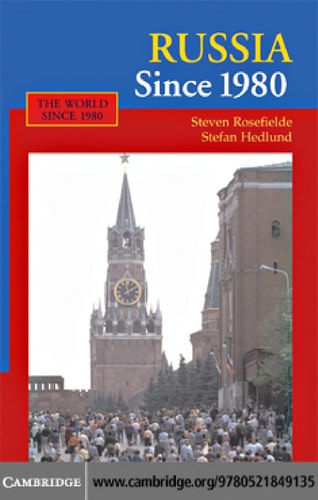
Russia Since 1980
0
0
As an Amazon Associate and affiliate partner, Menrva Books earns from qualifying purchases. Learn more
Author Description
Russia since 1980 recounts the epochal political, economic, and social changes that destroyed the Soviet Union, ushering in a perplexing new order. Two decades after Mikhail Gorbachev initiated his regime-wrecking radical reforms, Russia has reemerged as a superpower. It has survived a hyperdepression, modernized, restored private property and business, adopted a liberal democratic persona, and asserted claims to global leadership. Many in the West perceive these developments as proof of a better globalized tomorrow, while others foresee a new cold war. Globalizers contend that Russia is speedily democratizing, marketizing, and humanizing, creating a regime based on the rule of law and respect for civil rights. Opponents counterclaim that Russia before and during the Soviet period was similarly misportrayed and insist that Medvedev's Russia is just another variation of an authoritarian "Muscovite" model that has prevailed for more than five centuries. The cases for both positions are explored while chronicling events since 1980, and a verdict is rendered in favor of Muscovite continuity. Russia will continue challenging the West until it breaks with its cultural legacy.
Menrva's Summary
THE THESIS
The book investigates the complex and often contradictory transformations of Russia from the Soviet era to its reemergence as a global power. It examines the political, economic, and social changes that led to the dissolution of the Soviet Union and the subsequent rise of a new, perplexing order. The work analyzes the competing Western perceptions of Russia's democratization and marketization against the argument for a persistent authoritarian
THE SCOPE MAP
- An account of the epochal political, economic, and social changes that destroyed the Soviet Union.
- An analysis of Russia's reemergence as a superpower after surviving a hyperdepression and modernizing.
- Exploration of the adoption of a liberal democratic persona and assertions of global leadership.
- Examination of the debate between globalizers who see rapid democratization and opponents who argue for authoritarian continuity.
- A verdict favoring the argument of Muscovite continuity over Western perceptions.
- Discussion of Russia's ongoing challenge to the West stemming from its cultural legacy.
THE AUTHORITY PERSPECTIVE
The book presents a detailed chronicle of events since 1980, exploring the arguments for both rapid democratization and persistent authoritarianism in Russia. It ultimately renders a verdict in favor of Muscovite continuity, suggesting that Russia's challenges to the West are rooted in its deep cultural legacy. The work is positioned as a rigorous analysis for those seeking to understand the complex trajectory of modern Russia.
Page Count:
368
Publication Date:
2008-11-17
Publisher:
Cambridge University Press
ISBN-10:
0521613841
ISBN-13:
9780521613842
Politics
Economics
History
Non-Fiction
Community Tags
Similar Books














