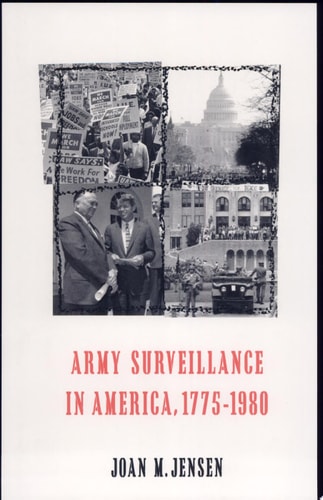
Army Surveillance in America, 1775-1980
0
0
As an Amazon Associate and affiliate partner, Menrva Books earns from qualifying purchases. Learn more
Author Description
Since the Revolution, Americans have debated what action the military should take toward civilians suspected of espionage, treason, or revolutionary activity. This important book--the first to present a comprehensive history of military surveillance in the United States--traces the evolution of America's internal security policy during the past two hundred years. Joan M. Jensen discusses how the federal government has used the army to intervene in domestic crises and how Americans have protested the violation of civil liberties and applied political pressure to limit military intervention in civil disputes. Although movements to expand and to constrain the military have each dominated during different periods in American history, says Jensen, the involvement of the army in internal security has increased steadily. Jensen describes a wide range of events and individuals connected to this process. These include Benedict Arnold's betrayal of West Point; the colonial wars in Cuba, where Lt. Andrew Rowan, the nation's first officer spy, won a medal for carrying a "Message for Garcia"; the development of "War Plans White" in the 1920s to guide the army's response in the event of domestic rebellion; the activities of J. Edgar Hoover and the FBI in the 1950s and 1960s; the use of the National Guard in the South at the height of the civil rights movement; and the surveillance of and violence against protesters during the Vietnam War. Scrutinizing the historic workings of the American government at closer range than has ever been done before, Jensen creates a vivid picture of the growing invisible intelligence empire within the United States government and of the men who created it.
Menrva's Summary
THE THESIS
The federal government has increasingly utilized the army for domestic surveillance and intervention, sparking ongoing debates about civil liberties. This book examines the historical evolution of American internal security policy from the Revolution to 1980, detailing how the army has been employed during domestic crises. It explores the tension between national security interests and the protection of civil liberties, highlighting periods of both expansion and constraint on military intervention. The author analyzes key events and figures that shaped this growing intelligence apparatus within the United States.
THE SCOPE MAP
- A comprehensive history of military surveillance in the United States from 1775 to 1980.
- Analysis of the federal government's use of the army in domestic crises and interventions.
- Discussion of American protests against the violation of civil liberties and efforts to limit military involvement.
- Case studies including Benedict Arnold's betrayal, the colonial wars in Cuba, "War Plans White," J. Edgar Hoover's FBI activities, the National Guard's role in the Civil Rights movement, and surveillance during the Vietnam War.
- Examination of the development of the U.S. government's intelligence empire.
THE AUTHORITY PERSPECTIVE
This book is recognized as a foundational text for understanding the historical trajectory of military surveillance within the United States. It is noted for its comprehensive scope, tracing the evolution of internal security policy over two centuries. The work is appreciated for its detailed examination of specific historical events and the complex interplay between government intervention and civil liberties. It provides a critical perspective on the growth of the American intelligence apparatus.
Page Count:
325
Publication Date:
1991-01-01
Publisher:
Yale University Press
ISBN-10:
0300046685
ISBN-13:
9780300046687
Politics
History
Non-Fiction
Surveillance
Military History
Community Tags
Similar Books