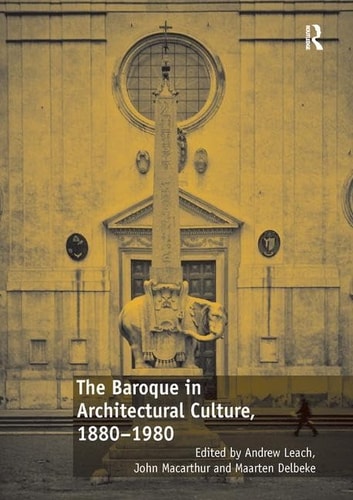
The Baroque in Architectural Culture, 1880-1980
0
0
As an Amazon Associate and affiliate partner, Menrva Books earns from qualifying purchases. Learn more
Author Description
In his landmark volume Space, Time and Architecture, Sigfried Giedion paired images of two iconic spirals: Tatlin's Monument to the Third International and Borromini's dome for Sant'Ivo alla Sapienza. The values shared between the baroque age and the modern were thus encapsulated on a single page spread. As Giedion put it, writing of Sant'Ivo, Borromini accomplished 'the movement of the whole pattern [...] from the ground to the lantern, without entirely ending even there.' And yet he merely 'groped' towards that which could 'be completely effected' in modern architecture-achieving 'the transition between inner and outer space.' The intellectual debt of modern architecture to modernist historians who were ostensibly preoccupied with the art and architecture of earlier epochs is now widely acknowledged. This volume extends this work by contributing to the dual projects of the intellectual history of modern architecture and the history of architectural historiography. It considers the varied ways that historians of art and architecture have historicized modern architecture through its interaction with the baroque: a term of contested historical and conceptual significance that has often seemed to shadow a greater contest over the historicity of modernism. Presenting research by an international community of scholars, this book explores through a series of cross sections the traffic of ideas between practice and history that has shaped modern architecture and the academic discipline of architectural history across the long twentieth century. The editors use the historiography of the baroque as a lens through which to follow the path of modern ideas that draw authority from history. In doing so, the volume defines a role for the baroque in the history of architectural historiography and in the history of modern architectural culture.
Menrva's Summary
THE THESIS
This volume investigates the complex relationship between Baroque art and modern architectural culture through the lens of historical interpretation. It examines how art and architectural historians in the 20th century utilized the Baroque period to legitimize and understand modern architectural movements, focusing on the contested significance of the Baroque as a concept. The book explores the intellectual lineage from modernist historians to contemporary architectural discourse, analyzing the traffic of ideas between architectural practice and its historical study.
THE SCOPE MAP
- Analysis of Sigfried Giedion's pairing of Tatlin and Borromini as a foundational moment in modernist historiography.
- Exploration of how the Baroque has been historicized as a precursor or influence on modern architecture.
- Examination of the term 'Baroque' itself as a site of historical and conceptual contestation.
- Research by an international community of scholars on the interaction between Baroque and modern architectural ideas.
- Cross-sections of the traffic of ideas between architectural practice and history across the 20th century.
- A definition of the Baroque's role in architectural historiography and modern architectural culture.
THE AUTHORITY PERSPECTIVE
This scholarly work is positioned as a significant contribution to the intellectual history of modern architecture and the field of architectural historiography. By using the historiography of the Baroque as a critical lens, it aims to illuminate the ways in which modern architectural ideas have drawn authority from historical precedents. The collection of research from international scholars suggests a comprehensive exploration of the dynamic between historical interpretation and the development of modern architectural culture.
Page Count:
296
Publication Date:
2017-01-01
Publisher:
Routledge, Taylor & Francis Group
ISBN-10:
1138573280
ISBN-13:
9781138573284
Non-Fiction
History
Art
Architecture
Modernism
Art History
Historiography
Community Tags
Similar Books