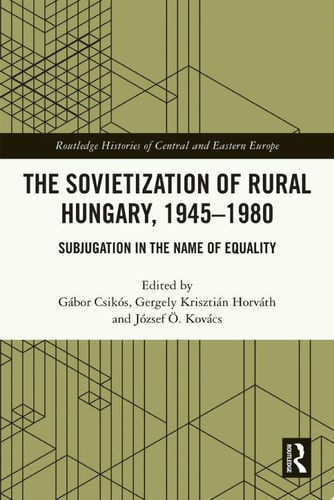
The Sovietization of Rural Hungary, 1945-1980
0
0
As an Amazon Associate and affiliate partner, Menrva Books earns from qualifying purchases. Learn more
Author Description
In this book the experiential history of the Soviet-style social transformation projects between 1945 and 1980 is discussed through the example of rural Hungary. The book interprets state socialism as a (modernization) project. Existing socialism was a form of dictatorship in which authorities sought to transform the mentalities of their subjects from the individual level to the global scale. This project depended on socio-economic homogenization; one important method of asserting state power was the transformation of property rights (land redistribution, collectivization). Communist modernization discriminated against the inhabitants of rural areas, who were the primary victims of collectivization and the discriminatory effects of the rules implemented by policymakers. The resulting radical changes in peasant lifestyles would become a source of social pathologies. However, not the authorities but contemporary scholars considered the social costs of these actions. The book aims at Weberian disenchantment and contributes to the deconstruction of the common image of Hungarian socialism, "the happiest barrack." The intended audience includes readers at the graduate level in the fields of history, political science, and anthropology, general readers interested in the history of communism. It is hoped that the research questions inspire new research for exploring convergent and divergent elements in social transformation in former communist countries.
Menrva's Summary
THE THESIS
The Sovietization of Rural Hungary, 1945-1980 examines the profound and often detrimental social transformation projects imposed on rural Hungary under Soviet-style state socialism. The book interprets this period as a modernization project where authorities aimed to reshape individual mentalities and societal structures through socio-economic homogenization. A primary method of asserting state power involved the radical alteration of property rights, particularly through land redistribution and collectivization, which disproportionately affected the rural population. The resulting disruption of traditional peasant lifestyles led to significant social pathologies, with the contemporary scholars, rather than the authorities, documenting the immense social costs.
THE SCOPE MAP
- The experiential history of Soviet-style social transformation projects in rural Hungary from 1945 to 1980.
- An interpretation of state socialism as a modernization project focused on transforming mentalities and societal structures.
- Analysis of the transformation of property rights, including land redistribution and collectivization, as a tool of state power.
- Examination of the discriminatory effects of policies implemented by policymakers on rural inhabitants.
- Discussion of the social pathologies resulting from radical changes in peasant lifestyles.
- Contribution to the deconstruction of the common image of Hungarian socialism, aiming for Weberian disenchantment.
- Research questions intended to inspire new research on social transformation in former communist countries.
THE AUTHORITY PERSPECTIVE
The book is intended for graduate-level readers in history, political science, and anthropology, as well as general readers interested in the history of communism. The authors aim for a Weberian disenchantment, contributing to a deconstruction of the popular image of Hungarian socialism. The research questions are designed to stimulate further academic inquiry into convergent and divergent elements of social transformation across former communist nations. The focus on experiential history and the critical examination of state-led modernization projects suggest a scholarly and analytical approach to the subject.
Page Count:
202
Publication Date:
2023-06-05
Publisher:
Taylor & Francis
ISBN-10:
1000892441
ISBN-13:
9781000892444
Politics
History
Non-Fiction
Eastern European Studies
Social Science
Community Tags
Similar Books