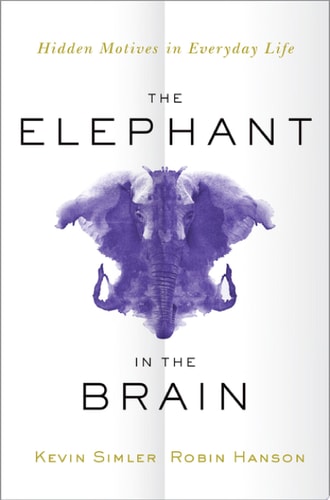
The Elephant in the Brain: Hidden Motives in Everyday Life
0
0
As an Amazon Associate and affiliate partner, Menrva Books earns from qualifying purchases. Learn more
Author Description
Human beings are primates, and primates are political animals. Our brains, therefore, are designed not just to hunt and gather, but also to help us get ahead socially, often via deception and self-deception. But while we may be self-interested schemers, we benefit by pretending otherwise. The less we know about our own ugly motives, the better - and thus we don't like to talk or even think about the extent of our selfishness. This is "the elephant in the brain." Such an introspective taboo makes it hard for us to think clearly about our nature and the explanations for our behavior. The aim of this book, then, is to confront our hidden motives directly - to track down the darker, unexamined corners of our psyches and blast them with floodlights. Then, once everything is clearly visible, we can work to better understand ourselves: Why do we laugh? Why are artists sexy? Why do we brag about travel? Why do we prefer to speak rather than listen?Our unconscious motives drive more than just our private behavior; they also infect our venerated social institutions such as Art, School, Charity, Medicine, Politics, and Religion. In fact, these institutions are in many ways designed to accommodate our hidden motives, to serve covert agendas alongside their "official" ones. The existence of big hidden motives can upend the usual political debates, leading one to question the legitimacy of these social institutions, and of standard policies designed to favor or discourage them. You won't see yourself - or the world - the same after confronting the elephant in the brain.
Menrva's Summary
THE THESIS
This book investigates the core question of why human beings consistently harbor hidden, self-interested motives that they actively conceal from themselves and others. Authors Kevin Simler and Robin Hanson, drawing on backgrounds in software engineering and economics, present a framework centered on the evolutionary necessity of social signaling and the psychological mechanism of self-deception. They argue that our brains are optimized for social maneuvering, leading us to construct elaborate rationalizations for behaviors that serve covert agendas rather than their stated, altruistic purposes.
THE SCOPE MAP
What You Will Find
- An analysis of evolutionary psychology as it pertains to social status and group dynamics.
- A breakdown of how hidden motives influence major social institutions including education, medicine, and politics.
- The concept of the 'elephant in the brain' as a metaphor for the collective avoidance of uncomfortable truths about human nature.
Scope Limits
- The text does not provide a comprehensive clinical guide to overcoming these biases.
- It focuses primarily on evolutionary and economic explanations, potentially overlooking alternative sociological or cultural frameworks.
THE AUTHORITY PERSPECTIVE
Readers frequently note the provocative nature of the authors' arguments, which challenge conventional views on human altruism and institutional integrity. Experts in the field of behavioral science often highlight this work as a significant contribution to the study of self-deception and social signaling.
Page Count:
416
Publication Date:
2018-01-02
Publisher:
Oxford University Press
ISBN-10:
0190495995
ISBN-13:
9780190495992
Non-Fiction
Psychology
Behavioral Science
Self-deception
Sociology
Evolutionary Psychology
Community Tags
Other Editions(2)

Similar Books