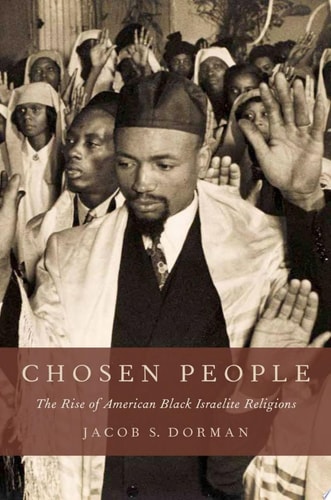
Chosen People: The Rise of American Black Israelite Religions
0
0
As an Amazon Associate and affiliate partner, Menrva Books earns from qualifying purchases. Learn more
Author Description
Named Outstanding Academic Title by CHOICEWinnter of the Wesley-Logan Prize of the American Historical AssociationWinner of the Byon Caldwell Smith Book PrizeWinner of the 2014 Albert J. Raboteau Book Prize for the Best Book in Africana ReligionsJacob S. Dorman offers new insights into the rise of Black Israelite religions in America, faiths ranging from Judaism to Islam to Rastafarianism all of which believe that the ancient Hebrew Israelites were Black and that contemporary African Americans are their descendants. Dorman traces the influence of Israelite practices and philosophies in the Holiness Christianity movement of the 1890s and the emergence of the Pentecostal movement in 1906. An examination of Black interactions with white Jews under slavery shows that the original impetus for Christian Israelite movements was not a desire to practice Judaism but rather a studied attempt to recreate the early Christian church, following the strictures of the Hebrew Scriptures.A second wave of Black Israelite synagogues arose during the Great Migration of African Americans and West Indians to cities in the North. One of the most fascinating of the Black Israelite pioneers was Arnold Josiah Ford, a Barbadian musician who moved to Harlem, joined Marcus Garvey's Black Nationalist movement, started his own synagogue, and led African Americans to resettle in Ethiopia in 1930. The effort failed, but the Black Israelite theology had captured the imagination of settlers who returned to Jamaica and transmitted it to Leonard Howell, one of the founders of Rastafarianism and himself a member of Harlem's religious subculture. After Ford's resettlement effort, the Black Israelite movement was carried forward in the U.S. by several Harlem rabbis, including Wentworth Arthur Matthew, another West Indian, who creatively combined elements of Judaism, Pentecostalism, Freemasonry, the British Anglo-Israelite movement, Afro-Caribbean faiths, and occult kabbalah.Drawing on interviews, newspapers, and archival records, Dorman provides a rich and nuanced history of these movements.
Menrva's Summary
THE THESIS
This work investigates the historical origins and theological development of Black Israelite religions in America, exploring how these movements emerged from a synthesis of Christian, Jewish, and African diasporic traditions. Jacob S. Dorman, a historian of religion, utilizes extensive archival research, including newspapers and personal interviews, to map the evolution of these faiths. He argues that these movements were not merely attempts to adopt Judaism, but were complex responses to the American racial landscape, deeply rooted in the desire to reclaim an ancient, pre-colonial identity. The book provides a framework for understanding how these ideologies influenced broader cultural shifts, including the rise of Pentecostalism and Rastafarianism.
THE SCOPE MAP
What You Will Find
- Historical analysis of the 1890s Holiness Christianity movement and the 1906 Pentecostal emergence.
- Biographical accounts of key figures such as Arnold Josiah Ford and Wentworth Arthur Matthew.
- Examination of the intersection between Black Nationalism, Freemasonry, and occult traditions.
- Documentation of the migration of theological ideas between Harlem, the American South, and the Caribbean.
Scope Limits
- The text focuses primarily on the American and Caribbean contexts, leaving out detailed analysis of contemporary global Black Israelite movements post-1960s.
- It does not provide a comprehensive theological critique of the movements' doctrines, focusing instead on their historical and sociological development.
THE AUTHORITY PERSPECTIVE
Scholars and critics recognize this work as a foundational text for understanding the complex religious landscape of the African diaspora in the United States. Readers frequently note the academic density of the prose, which is balanced by the author's meticulous use of primary source material to reconstruct often-overlooked historical narratives.
Page Count:
322
Publication Date:
2016-03-01
Publisher:
Oxford University Press
ISBN-10:
0190490098
ISBN-13:
9780190490096
History
Religion
African American
Sociology of Religion
Cultural History
Black Hebrews
Community Tags
Similar Books




Reader Comments
Share Your Thoughts
No comments yet. Be the first to share your thoughts!