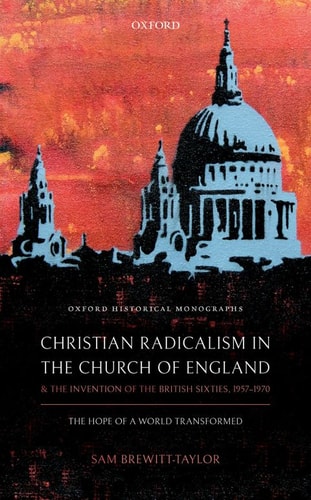
Christian Radicalism in the Church of England and the Invention of the British Sixties, 1957-1970: The Hope of a World Transformed
0
0
As an Amazon Associate and affiliate partner, Menrva Books earns from qualifying purchases. Learn more
Author Description
This study provides the first postsecular account of the moral revolution that Britain experienced in the 1960s. Beginning from the groundbreaking premise that secularity is not a mere absence, but an invented culture, it argues that a new form of British secularity achieved cultural dominance during an abrupt cultural revolution which occurred in the late 1950s and early 1960s. This moral revolution had little to do with affluence or technology, but was most centrally a cultural response to the terrors of the Cold War, which pitted Christian Britain against the secular Soviet Union. By exploring contemporary prophecies of the inevitable arrival of 'the secular society', Sam Brewitt-Taylor shows that, ironically, British secularity was given decisive initial momentum by theologically radical Christians, who destigmatized the idea of 'modern secularity' and made it available for appropriation by a wide range of Sixties actors. Further than this, radical Christians played a significant contributory role in deciding what kind of secularity Britain's Sixties would adopt, by narrating Britain's moral revolution as globalist, individualist, anti-authoritarian, sexually libertarian, and politically egalitarian. In all these ways, radical Christians played a highly significant role in the early stages of Britain's Sixties.
Menrva's Summary
THE THESIS
This study investigates the role of radical Christian theology in the formation of British secular culture during the 1960s. Sam Brewitt-Taylor, a historian specializing in modern British religious history, utilizes archival research and contemporary theological texts to challenge the narrative that secularization was a purely external force. He argues that radical members of the Church of England actively destigmatized secularity, effectively shaping the moral and cultural framework of the era as a response to Cold War anxieties.
THE SCOPE MAP
What You Will Find
- Analysis of the cultural shift in Britain between 1957 and 1970.
- Examination of the intersection between Cold War politics and religious discourse.
- Investigation into how theological radicalism influenced concepts of individualism and sexual liberation.
Scope Limits
- The study focuses primarily on the Church of England and does not provide an exhaustive account of non-Christian secular movements.
- It does not cover the long-term institutional decline of the church beyond the immediate context of the 1960s.
THE AUTHORITY PERSPECTIVE
Scholars in the field of religious history recognize this work as a significant contribution to postsecular studies. Readers frequently note the academic density of the prose and the author's meticulous use of primary source material to support his historical arguments.
Page Count:
286
Publication Date:
2018-01-01
Publisher:
OUP Oxford
ISBN-10:
0192561855
ISBN-13:
9780192561855
History
Sociology of Religion
Great Britain
Radicalism
20th Century
Cultural History
European History
British History
Radicals
Religious History
Community Tags
Similar Books