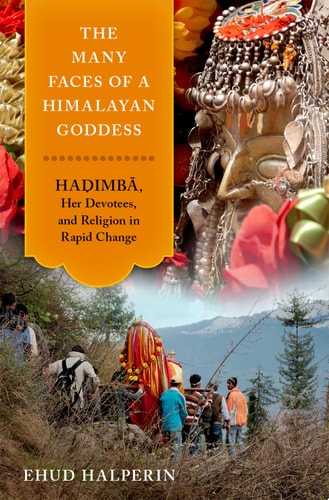
The Many Faces of a Himalayan Goddess: Hadimba, Her Devotees, and Religion in Rapid Change
0
0
As an Amazon Associate and affiliate partner, Menrva Books earns from qualifying purchases. Learn more
Author Description
Hadimba is a primary village goddess in the Kullu Valley of the West Indian Himalayan state of Himachal Pradesh, a rural area known as the Land of Gods. As the book shows, Hadimba is a goddess whose vitality reveals itself in her devotees' rapidly changing encounters with local and far from local players, powers, and ideas. These include invading royal forces, colonial forms of knowledge, and more recently the onslaught of modernity, capitalism, tourism, and ecological change. Hadimba has provided her worshipers with discursive, ritual, and ideological arenas within which they reflect on, debate, give meaning to, and sometimes resist these changing realities, and she herself has been transformed in the process.Drawing on diverse ethnographic and textual materials gathered in the region from 2009 to 2017, The Many Faces of a Himalayan Goddess is rich with myths and tales, accounts of dramatic rituals and festivals, and descriptions of everyday life in the celebrated but remote Kullu Valley. The book employs an interdisciplinary approach to tell the story of Hadimba from the ground up, or rather, from the center out, portraying the goddess in varying contexts that radiate outward from her temple to local, regional, national, and indeed global spheres. The result is an important contribution to the study of Indian village goddesses, lived Hinduism, Himalayan Hinduism, and the rapidly growing field of religion and ecology.
Menrva's Summary
THE THESIS
This book investigates how the village goddess Hadimba serves as a dynamic focal point for the inhabitants of the Kullu Valley as they navigate the pressures of modernity, capitalism, and ecological shifts. Ehud Halperin, a scholar specializing in South Asian religions, utilizes extensive ethnographic fieldwork and textual analysis conducted between 2009 and 2017. He argues that the goddess is not a static icon but a transformative figure whose identity evolves alongside the socio-political and economic realities of her devotees. By examining the intersection of ritual practice and external influence, the author provides a framework for understanding how local religious traditions adapt to globalized forces.
THE SCOPE MAP
What You Will Find
- Ethnographic data from the Kullu Valley spanning 2009 to 2017
- Analysis of the intersection between local deity worship and modern capitalism
- Examination of religious responses to tourism and ecological change
- Case studies on ritual performance and myth-making in Himachal Pradesh
Scope Limits
- The study is geographically confined to the Kullu Valley region
- It does not provide a comprehensive history of all Himalayan deities
THE AUTHORITY PERSPECTIVE
Scholars in the field of lived Hinduism and Himalayan studies recognize this work as a significant contribution to the understanding of localized religious adaptation. Readers frequently note the academic rigor of the ethnographic research and the clarity with which the author connects micro-level village practices to broader global trends.
Page Count:
289
Publication Date:
2019-01-01
Publisher:
Oxford University Press
ISBN-10:
0190913606
ISBN-13:
9780190913601
Religion
Cultural History
Hinduism
India religion
Sociology of Religion
Anthropology
Community Tags
Similar Books