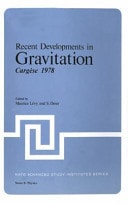
Recent Developments in Gravitation Cargèse 1978
0
0
As an Amazon Associate and affiliate partner, Menrva Books earns from qualifying purchases. Learn more
Author Description
The theory of General Relativity, after its invention by Albert Einstein, remained for many years a monument of mathemati cal speculation, striking in its ambition and its formal beauty, but quite separated from the main stream of modern Physics, which had centered, after the early twenties, on quantum mechanics and its applications. In the last ten or fifteen years, however, the situation has changed radically. First, a great deal of significant exper~en tal data became available. Then important contributions were made to the incorporation of general relativity into the framework of quantum theory. Finally, in the last three years, exciting devel opments took place which have placed general relativity, and all the concepts behind it, at the center of our understanding of par ticle physics and quantum field theory. Firstly, this is due to the fact that general relativity is really the "original non-abe lian gauge theory," and that our description of quantum field in teractions makes extensive use of the concept of gauge invariance. Secondly, the ideas of supersymmetry have enabled theoreticians to combine gravity with other elementary particle interactions, and to construct what is perhaps the first approach to a more finite quantum theory of gravitation, which is known as super gravity.
Menrva's Summary
THE THESIS
The theory of General Relativity has transitioned from a theoretical curiosity to a central pillar of modern physics. Once considered a beautiful but isolated mathematical construct, it has recently become integral to understanding particle physics and quantum field theory, driven by new experimental data and theoretical advancements in its incorporation into quantum mechanics. The concepts of non-abelian gauge theories and supersymmetry have further propelled its relevance, leading to the development of supergravity as a potential finite quantum theory of gravitation.
THE SCOPE MAP
- The historical development of General Relativity and its relationship with quantum mechanics.
- The incorporation of general relativity into the framework of quantum theory.
- The role of general relativity as a non-abelian gauge theory.
- The impact of supersymmetry on combining gravity with elementary particle interactions.
- An introduction to supergravity as an approach to a finite quantum theory of gravitation.
THE AUTHORITY PERSPECTIVE
This collection of lectures from Cargèse 1978 likely presents advanced theoretical physics concepts to a specialized audience. The subject matter, focusing on the resurgence of General Relativity and its connections to quantum field theory and particle physics, suggests a dense and technical treatment. The emphasis on gauge theories and supersymmetry indicates a forward-looking perspective for its time, aimed at researchers and academics deeply involved in theoretical physics.
Page Count:
596
Publication Date:
2011-10-18
Publisher:
Springer US
ISBN-10:
1461329574
ISBN-13:
9781461329572
Non-Fiction
Science
Quantum Theory
Physics
General Relativity
Gauge Theory
Gravitation
Supersymmetry
Community Tags
Similar Books