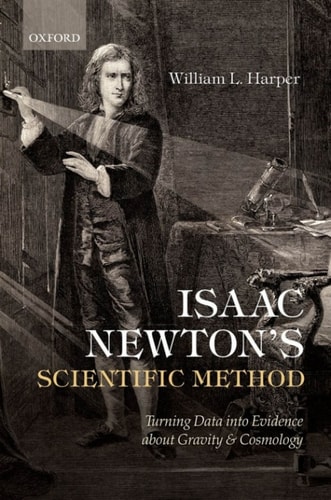
Isaac Newton's Scientific Method: Turning Data into Evidence about Gravity and Cosmology
0
0
As an Amazon Associate and affiliate partner, Menrva Books earns from qualifying purchases. Learn more
Author Description
Isaac Newton's Scientific Method examines Newton's argument for universal gravity and his application of it to resolve the problem of deciding between geocentric and heliocentric world systems by measuring masses of the sun and planets. William L. Harper suggests that Newton's inferences from phenomena realize an ideal of empirical success that is richer than prediction. Any theory that can achieve this rich sort of empirical success must not only be able to predict the phenomena it purports to explain, but also have those phenomena accurately measure the parameters which explain them. Harper explores the ways in which Newton's method aims to turn theoretical questions into ones which can be answered empirically by measurement from phenomena, and to establish that propositions inferred from phenomena are provisionally accepted as guides to further research. This methodology, guided by its rich ideal of empirical success, supports a conception of scientific progress that does not require construing it as progress toward Laplace's ideal limit of a final theory of everything, and is not threatened by the classic argument against convergent realism. Newton's method endorses the radical theoretical transformation from his theory to Einstein's. Harper argues that it is strikingly realized in the development and application of testing frameworks for relativistic theories of gravity, and very much at work in cosmology today.
Menrva's Summary
THE THESIS
This book investigates how Isaac Newton’s scientific methodology established a rigorous framework for empirical success that transcends mere predictive accuracy. William L. Harper, a philosopher of science, utilizes historical analysis of Newton’s Principia to demonstrate how the physicist transformed theoretical inquiries into measurable empirical data. The author argues that Newton’s approach provides a robust model for scientific progress that remains relevant to modern cosmology and relativistic gravity testing.
THE SCOPE MAP
What You Will Find
- Analysis of Newton’s arguments for universal gravity and planetary mass measurement.
- A detailed examination of the transition from geocentric to heliocentric world systems.
- A philosophical framework for understanding empirical success beyond predictive power.
- Connections between Newtonian methodology and contemporary relativistic gravity research.
Scope Limits
- The text does not provide a comprehensive biography of Newton’s personal life.
- It does not attempt to cover the entirety of 17th-century scientific history outside of the specific context of gravitational theory.
THE AUTHORITY PERSPECTIVE
Scholars and historians of science recognize this work as a significant contribution to the understanding of Newtonian methodology and its enduring influence on scientific practice. Readers frequently note the academic density of the prose, which is tailored for those with a background in the philosophy of physics or the history of science.
Page Count:
360
Publication Date:
2012-01-01
Publisher:
Oxford University Press
ISBN-10:
0191617903
ISBN-13:
9780191617904
Philosophy
Biography
Science
Philosophy of
Gravitation
Gravity
Astronomy
Science History
Physics
Community Tags
Similar Books