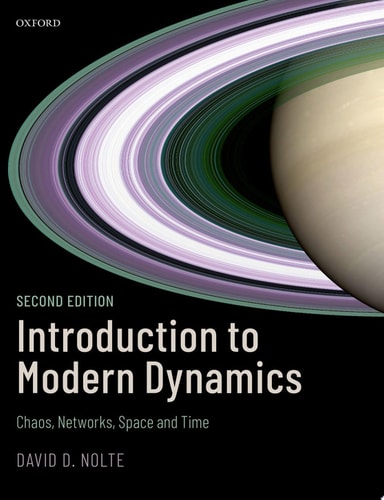
Introduction to Modern Dynamics: Chaos, Networks, Space and Time
0
0
As an Amazon Associate and affiliate partner, Menrva Books earns from qualifying purchases. Learn more
Author Description
The best parts of physics are the last topics that our students ever see. These are the exciting new frontiers of nonlinear and complex systems that are at the forefront of university research and are the basis of many high-tech businesses. Topics such as traffic on the World Wide Web, the spread of epidemics through globally-mobile populations, or the synchronization of global economies are governed by universal principles just as profound as Newton's laws. Nonetheless, the conventional university physics curriculum reserves most of these topics for advanced graduate study. Two justifications are given for this situation: first, that the mathematical tools needed to understand these topics are beyond the skill set of undergraduate students, and second, that these are speciality topics with no common theme and little overlap. Introduction to Modern Dynamics dispels these myths. The structure of this book combines the three main topics of modern dynamics - chaos theory, dynamics on complex networks, and general relativity - into a coherent framework. By taking a geometric view of physics, concentrating on the time evolution of physical systems as trajectories through abstract spaces, these topics share a common and simple mathematical language through which any student can gain a unified physical intuition. Given the growing importance of complex dynamical systems in many areas of science and technology, this text provides students with an up-to-date foundation for their future careers.
Menrva's Summary
THE THESIS
This book investigates whether the complex topics of chaos, networks, and general relativity can be unified into a single, accessible framework for undergraduate physics students. David D. Nolte, a professor of physics, argues that these subjects are often incorrectly relegated to graduate study due to perceived mathematical difficulty. By utilizing a geometric approach that views physical systems as trajectories through abstract spaces, the author provides a common mathematical language to bridge these seemingly disparate fields.
THE SCOPE MAP
What You Will Find
- A unified geometric framework for analyzing dynamical systems.
- Mathematical tools for understanding chaos theory and complex networks.
- Applications of dynamical principles to real-world phenomena like web traffic and epidemic spread.
- Conceptual foundations of general relativity integrated into a broader dynamical context.
Scope Limits
- The text assumes a baseline level of undergraduate physics knowledge.
- It does not provide an exhaustive treatment of every sub-field within nonlinear dynamics.
THE AUTHORITY PERSPECTIVE
Experts and educators recognize this text as a bridge between traditional undergraduate curricula and advanced research topics. Readers frequently note that the book successfully simplifies complex mathematical concepts, making it a valuable resource for students seeking a unified intuition of modern physical systems.
Page Count:
432
Publication Date:
2014-01-01
Publisher:
OUP Oxford
ISBN-10:
0191631450
ISBN-13:
9780191631450
Science
Dynamics
Chaos Theory
Complex Networks
Modern Physics
textbook
Earth Sciences
General Relativity
Physics
Community Tags
Similar Books