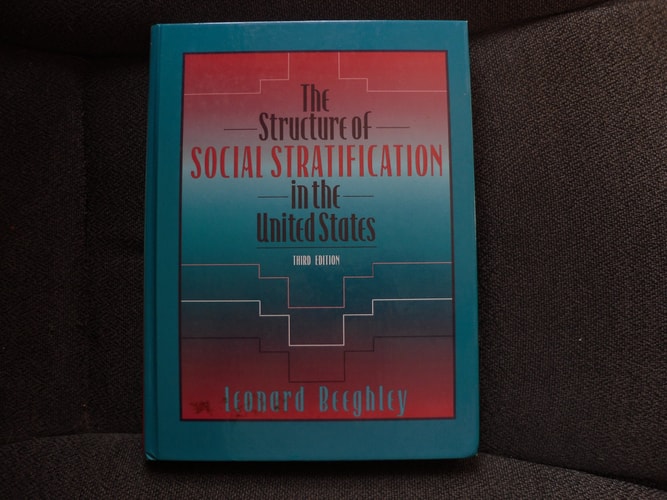
The Structure of Social Stratification in the United States
0
0
As an Amazon Associate and affiliate partner, Menrva Books earns from qualifying purchases. Learn more
Author Description
Stratification structure refers to the hierarchy of social classes in society. This book describes the class structure in the United States, focusing on the way people's class location influences their opportunities. To do this, Beeghley emphasizes three themes. The first theme is that power influences the distribution of resources in the United States. The second theme is that the social structure influences rates of events, mainly because it determines people's range of choices. The third theme is that social psychological factors influence how individuals act on, and react to, the situations in which they find themselves. One purpose of this book is to help readers to understand social inequality from a new angle of vision. Such an orientation implies that social facts are not always what they seem to be, an insight that is fundamental to sociology. For readers interested in society's class structure in relation to individual action and reaction.
Menrva's Summary
THE THESIS
This book investigates how the hierarchy of social classes in the United States functions as a structural determinant of individual opportunity and societal outcomes. Leonard Beeghley, a sociologist, utilizes a framework centered on the interplay between power, structural constraints, and social psychology to analyze American inequality. By examining how class location dictates the range of available choices, the author challenges conventional perceptions of social facts and individual agency. The text serves as an analytical guide for understanding the systemic mechanisms that maintain and reproduce stratification within the American context.
THE SCOPE MAP
What You Will Find
- Analysis of the relationship between power dynamics and the distribution of societal resources.
- Examination of how social structures influence the rates of various life events and outcomes.
- Exploration of social psychological factors that shape individual reactions to class-based situations.
- A sociological framework designed to provide a new perspective on the nature of social inequality.
THE AUTHORITY PERSPECTIVE
The text is regarded as a foundational academic resource for students and scholars seeking a structured, sociological approach to American class dynamics. Its emphasis on the intersection of structural constraints and individual psychology provides a clear, analytical lens for interpreting complex social stratification patterns.
Page Count:
332
Publication Date:
1989-01-01
Publisher:
Allyn & Bacon
ISBN-10:
0205117899
ISBN-13:
9780205117895
Social Classes
American Studies
United States
Sociology
Social Science
Community Tags
Other Editions(4)

Similar Books