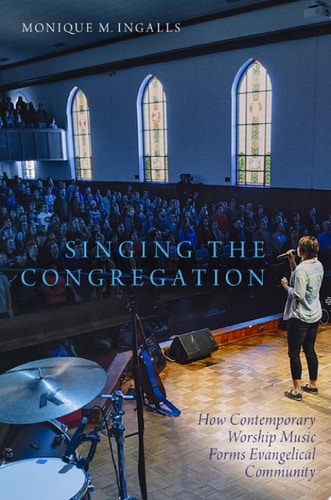
Singing the Congregation: How Contemporary Worship Music Forms Evangelical Community
0
0
As an Amazon Associate and affiliate partner, Menrva Books earns from qualifying purchases. Learn more
Author Description
Contemporary worship music shapes the way evangelical Christians understand worship itself. Author Monique M. Ingalls argues that participatory worship music performances have brought into being new religious social constellations, or "modes of congregating". Through exploration of five of these modes--concert, conference, church, public, and networked congregations--Singing the Congregation reinvigorates the analytic categories of "congregation" and "congregational music." Drawing from theoretical models in ethnomusicology and congregational studies, Singing the Congregation reconceives the congregation as a fluid, contingent social constellation that is actively performed into being through communal practice--in this case, the musically-structured participatory activity known as "worship." "Congregational music-making" is thereby recast as a practice capable of weaving together a religious community both inside and outside local institutional churches. Congregational music-making is not only a means of expressing local concerns and constituting the local religious community; it is also a powerful way to identify with far-flung individuals, institutions, and networks that comprise this global religious community. The interactions among the congregations reveal widespread conflicts over religious authority, carrying far-ranging implications for how evangelicals position themselves relative to other groups in North America and beyond.
Menrva's Summary
THE THESIS
How does contemporary worship music function as a mechanism for constructing and maintaining evangelical social identity? Monique Marie Ingalls, an expert in ethnomusicology and congregational studies, investigates the intersection of musical performance and religious community formation. She posits that worship music is not merely an expressive act but a performative practice that actively constitutes religious social constellations, which she defines as 'modes of congregating.'
THE SCOPE MAP
What You Will Find
- Analysis of five distinct modes of congregating: concert, conference, church, public, and networked.
- Theoretical frameworks derived from ethnomusicology and congregational studies.
- Examination of how music facilitates identification with global religious networks.
Scope Limits
- The study focuses primarily on North American evangelical contexts and may not fully account for non-Western or non-evangelical liturgical traditions.
- The research does not provide a comprehensive history of worship music, focusing instead on contemporary sociological functions.
THE AUTHORITY PERSPECTIVE
Scholars in the fields of musicology and religious studies recognize this work as a significant contribution to the understanding of how digital and physical spaces shape modern worship. Readers frequently note the academic density of the prose, which is well-suited for researchers and students of congregational music.
Page Count:
272
Publication Date:
2018-01-01
Publisher:
Oxford University Press
ISBN-10:
0190499664
ISBN-13:
9780190499662
Religion
Music
Contemporary Christian
Humanities
Evangelicalism
Worship Studies
Sociology of Religion
Community Tags
Similar Books