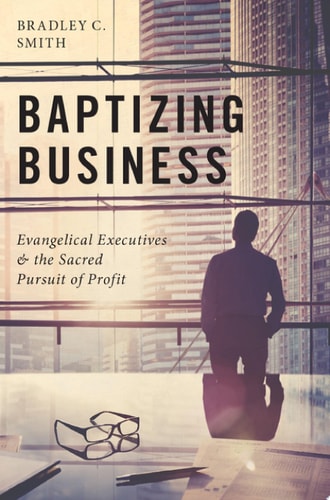
Baptizing Business: Evangelical Executives and the Sacred Pursuit of Profit
0
0
As an Amazon Associate and affiliate partner, Menrva Books earns from qualifying purchases. Learn more
Author Description
Baptizing Business sifts through popular perceptions regarding the relationship between business and religion and the agenda of conservative Christian business leaders, drawing on personal interviews with the most diverse group of evangelical executives yet studied.While stereotypes and previous research both emphasize the perceived incompatibility of religious mandates and business objectives, Bradley C. Smith argues that evangelical executives experience tension not because business and religion are inherently opposed, but because they are made to feel like second-class citizens by members of their own faith communities. Indeed, in cases of apparent conflict between faith and business, evangelical executives insist that it is faith, not business, that must be reconceived. Smith reveals that evangelical business leaders are as inclined to export business concepts into other domains as to import religious objectives into business contexts, prompting us to reconsider the direction of influence between religious and economic life.Baptizing Business is filled with compelling stories that paint a nuanced, unbiased picture of the increasing influence of intensely religious business leaders. The "spirit of capitalism," defined by Max Weber as a positive attitude toward work and wealth, finds ongoing embrace and new expression in evangelical executives and their accounts, with implications for our understanding of the faith at work movement, evangelicalism, and the role of religion among elites.
Menrva's Summary
THE THESIS
This book investigates the complex intersection of evangelical faith and corporate leadership, specifically questioning how religious executives reconcile their professional objectives with their spiritual identities. Bradley C. Smith, a scholar of religion and society, utilizes a robust dataset of personal interviews with a diverse cohort of evangelical executives. He argues that the perceived conflict between capitalism and faith is often a byproduct of internal pressure from religious communities rather than an inherent contradiction between the two spheres. The text posits that these leaders frequently adapt their religious understanding to fit the realities of the modern marketplace.
THE SCOPE MAP
What You Will Find
- Qualitative data derived from extensive interviews with evangelical business leaders.
- An analysis of the 'faith at work' movement and its influence on corporate strategy.
- A re-examination of Max Weber's 'spirit of capitalism' in a contemporary context.
Scope Limits
- The study focuses primarily on the American evangelical experience and does not cover global religious business practices.
- It does not provide a theological critique of capitalism but rather focuses on the sociological experience of the executives.
THE AUTHORITY PERSPECTIVE
Scholars and sociologists frequently note the book's success in challenging monolithic stereotypes regarding religious business leaders. Experts highlight this as a significant contribution to the study of how elite professionals navigate the tension between secular economic demands and personal belief systems.
Page Count:
216
Publication Date:
2020-08-10
Publisher:
Oxford University Press
ISBN-10:
0190055774
ISBN-13:
9780190055776
Economics
Politics
Religion
Business
Social Sciences - Religion - Christianity
Sociology of Religion
Communications
Skills
New Used & Rental Textbooks
Sociology
Christian Living
Evangelicalism
Business & Professional
Community Tags
Similar Books