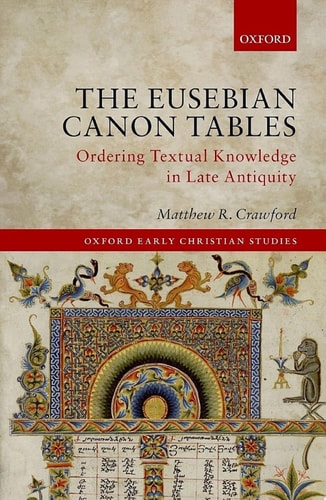
The Eusebian Canon Tables: Ordering Textual Knowledge in Late Antiquity
0
0
As an Amazon Associate and affiliate partner, Menrva Books earns from qualifying purchases. Learn more
Author Description
One of the books most central to late-antique religious life was the four-gospel codex, containing the Gospels of Matthew, Mark, Luke, and John. A common feature in such manuscripts was a marginal cross-referencing system known as the Canon Tables. This reading aid was invented in the early fourth century by Eusebius of Caesarea and represented a milestone achievement both in the history of the book and in the scholarly study of the fourfold gospel. In this work, Matthew R. Crawford provides the first book-length treatment of the origins and use of the Canon Tables apparatus in any language. Part one begins by defining the Canon Tables as a paratextual device that orders the textual content of the fourfold gospel. It then considers the relation of the system to the prior work of Ammonius of Alexandria and the hermeneutical implications of reading a four-gospel codex equipped with the marginal apparatus. Part two transitions to the reception of the paratext in subsequent centuries by highlighting four case studies from different cultural and theological traditions, from Augustine of Hippo, who used the Canon Tables to develop the first ever theory of gospel composition, to a Syriac translator in the fifth century, to later monastic scholars in Ireland between the seventh and ninth centuries. Finally, from the eighth century onwards, Armenian commentators used the artistic adornment of the Canon Tables as a basis for contemplative meditation. These four case studies represent four different modes of using the Canon Tables as a paratext and illustrate the potential inherent in the Eusebian apparatus for engaging with the fourfold gospel in a variety of ways, from the philological to the theological to the visual.
Menrva's Summary
THE THESIS
This work investigates the origins, function, and historical reception of the Eusebian Canon Tables as a transformative paratextual apparatus for the four-gospel codex. Matthew R. Crawford, a scholar of early Christian history, utilizes a combination of codicological analysis and historical reception studies to argue that these tables were not merely reading aids, but sophisticated tools that shaped how the fourfold gospel was interpreted, organized, and visually experienced across diverse cultural contexts in late antiquity and the early medieval period.
THE SCOPE MAP
What You Will Find
- A detailed examination of the Canon Tables as a paratextual device.
- Analysis of the relationship between Eusebius of Caesarea’s system and the earlier work of Ammonius of Alexandria.
- Four distinct case studies covering Augustine of Hippo, Syriac translation traditions, Irish monastic scholarship, and Armenian artistic commentary.
Scope Limits
- The study focuses primarily on the development and reception of the apparatus rather than a comprehensive catalog of every extant manuscript containing the tables.
THE AUTHORITY PERSPECTIVE
Scholars recognize this work as the first comprehensive, book-length treatment of the Eusebian Canon Tables, filling a significant gap in the study of early Christian manuscript culture. Readers frequently note the academic rigor and the clarity with which Crawford connects complex philological details to broader theological and visual traditions.
Page Count:
392
Publication Date:
2019-01-01
Publisher:
OUP Oxford
ISBN-10:
0192523589
ISBN-13:
9780192523587
History
Religion
Bibles
Bible
Late Antiquity
Christianity
Theology
Community Tags
Similar Books