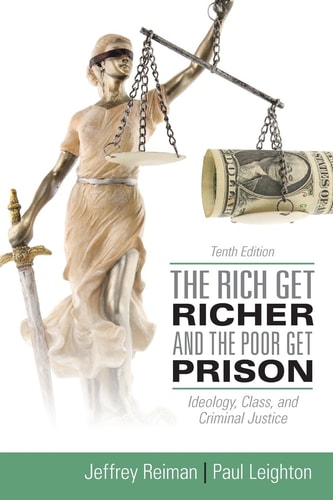
The Rich Get Richer and the Poor Get Prison: Ideology, Class, and Criminal Justice
0
0
As an Amazon Associate and affiliate partner, Menrva Books earns from qualifying purchases. Learn more
Author Description
Illustrates the issue of economic inequality within the American justice system.The best-selling text, The Rich Get Richer and the Poor Get Prison contends that the criminal justice system is biased against the poor from start to finish. The authors argue that even before the process of arrest, trial, and sentencing, the system is biased against the poor in what it chooses to treat as crime.The authors show that numerous acts of the well-off--such as their refusal to make workplaces safe, refusal to curtail deadly pollution, promotion of unnecessary surgery, and prescriptions for unnecessary drugs--cause as much harm as the acts of the poor that are treated as crimes. However, the dangerous acts of the well-off are almost never treated as crimes, and when they are, they are almost never treated as severely as the crimes of the poor. Not only does the criminal justice system fail to protect against the harmful acts of well-off people, it also fails to remedy the causes of crime, such as poverty. This results in a large population of poor criminals in our prisons and in our media. The authors contend that the idea of crime as a work of the poor serves the interests of the rich and powerful while conveying a misleading notion that the real threat to Americans comes from the bottom of society rather than the top.Learning GoalsUpon completing this book, readers will be able to: Examine the criminal justice system through the lens of the poor. Understand that much of what goes on in the criminal justice system violates one’s own sense of fairness. Morally evaluate the criminal justice system’s failures. Identify the type of legislature that is biased against the poor.Note: MySearchLab with eText does not come automatically packed with this text. To purchase MySearchLab with eText, please visit www.mysearchlab.com or you can purchase a ValuePack of the text + MySearchLab with eText (at no additional cost): ValuePack ISBN-10: 0205896103 / ValuePack ISBN-13: 9780205896103.
Menrva's Summary
THE THESIS
This text investigates the core question of why the American criminal justice system consistently produces outcomes that favor the wealthy while disproportionately penalizing the poor. Jeffrey Reiman and Paul Leighton utilize extensive sociological data and legal analysis to argue that the system is structurally biased, defining crime in ways that ignore the harmful actions of the elite—such as corporate negligence and environmental pollution—while focusing enforcement efforts on the street-level crimes of the impoverished. By examining the legislative and judicial processes, the authors demonstrate how this disparity serves to maintain existing power structures and distract the public from systemic economic inequality.
THE SCOPE MAP
What You Will Find
- Analysis of the legislative definitions of crime and how they exclude corporate and white-collar harms.
- Examination of the socioeconomic disparities present at every stage of the justice process, from arrest to sentencing.
- Case studies comparing the physical and financial damage caused by corporate negligence versus traditional street crime.
- A critical framework for evaluating the moral failures of the justice system in relation to poverty and social policy.
THE AUTHORITY PERSPECTIVE
This work is widely regarded as a foundational text in critical criminology, frequently utilized in academic settings to challenge conventional perceptions of crime and punishment. The analysis provides a rigorous, data-driven critique that forces readers to reconsider the intersection of economic power and legal enforcement.
Page Count:
304
Publication Date:
2012-01-01
Publisher:
Pearson
ISBN-10:
0205137725
ISBN-13:
9780205137725
Criminology
Social Classes
Sociology
Law
United States
Administration of Justice
Community Tags
Similar Books








Reader Comments
Share Your Thoughts
No comments yet. Be the first to share your thoughts!