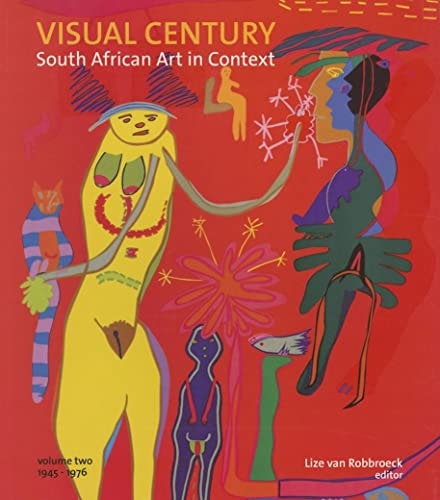
Visual Century: 1945-1976
0
0
As an Amazon Associate and affiliate partner, Menrva Books earns from qualifying purchases. Learn more
Author Description
In the second installment of the Visual Century Collection, the political and artistic search for national identity is explored. Visual Century: South African Art is a four-volume publication that reappraises South African visual art of the 20th century from a postapartheid perspective. It is the only publication that provides an overview of a century of South African art, with in-depth discussion by leading art historians and reproduction of a large number of artworks, providing readers with fresh perspectives on complexities that still resonate today. The second volume in the Visual Century series discusses how, between the end of the Second World War and the Soweto Uprisings, South Africa was increasingly isolated from the international world by its policies of racial exclusion and extreme social engineering. The threats to the state of internal revolt and external pressure, posed within the broader contexts of decolonization and the Cold War, caused it to adopt severe measures, with significant consequences for the art of the period. This volume then addresses the fertile cultural ambivalences of this period. These include the relationship between Afrikaner nationalism and the emergence of an 'official' South African art, whose central role would come to be challenged by the steady increase in the number of modern black artists and new informal art centers. Also discussed is the impact of white patronage, the responses of migrant workers to rapid change, and artists' responses to the repressive political climate of apartheid, as well as to emerging black nationalism. The allure and impact of European and American art capitals and modernist discourse, for artists at 'home' and in exile, and not least the struggles of black and white artists to define an African identity, is also explored.
Menrva's Summary
THE THESIS
This volume investigates the complex interplay between political upheaval and artistic expression in South Africa during a pivotal era of isolation and internal strife. Between the end of World War II and the Soweto Uprisings, South Africa's apartheid policies led to increasing international isolation, while internal pressures of decolonization and the Cold War fueled state repression. This context profoundly shaped the art of the period, challenging the emergence of an 'official' Afrikaner nationalism and fostering a growing presence of black artists and informal art centers. The book examines the cultural ambivalences, the impact of white patronage, the responses of migrant workers, and artists' struggles to define an African identity amidst a repressive climate and the allure of global modernist discourse.
THE SCOPE MAP
- Exploration of South African visual art from 1945 to 1976.
- Analysis of the search for national identity within a politically isolated South Africa.
- Discussion of the impact of apartheid policies on artistic creation and exhibition.
- Examination of the relationship between Afrikaner nationalism and 'official' art.
- Coverage of the rise of black artists and informal art centers.
- Analysis of white patronage and the responses of migrant workers to societal changes.
- Exploration of artists' reactions to apartheid and emerging black nationalism.
- Consideration of the influence of European and American art capitals and modernist discourse.
THE AUTHORITY PERSPECTIVE
As the second volume in the Visual Century Collection, this book offers a reappraisal of South African visual art from a post-apartheid perspective, providing an overview of a century of art with in-depth discussions by leading art historians. The content addresses the fertile cultural ambivalences of the period between 1945 and 1976, a time marked by increasing international isolation due to apartheid policies and internal pressures from decolonization and the Cold War. It delves into the challenges faced by artists in defining an African identity amidst a repressive political climate and the influence of global art movements. The publication is noted for its extensive reproduction of artworks, offering readers fresh perspectives on enduring complexities.
Page Count:
218
Publication Date:
2011-01-01
Publisher:
Wits University Press
ISBN-10:
1868145255
ISBN-13:
9781868145256
History
Art
Non-Fiction
National Identity
Art History
Community Tags
Similar Books



Reader Comments
Share Your Thoughts
No comments yet. Be the first to share your thoughts!