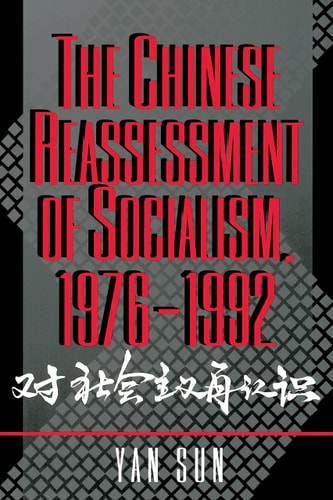
The Chinese Reassessment of Socialism, 1976-1992
0
0
As an Amazon Associate and affiliate partner, Menrva Books earns from qualifying purchases. Learn more
Author Description
A momentous debate has been unfolding in China over the last fifteen years, only intermittently in public view, concerning the merits of socialism as a philosophy of social justice and as a program for national development. Just as Deng Xiaoping's better advertised experiment with market- based reforms has challenged Marxist-Leninist dogma on economic policy, the years since the death of Mao Zedong have seen a profound reexamination of a more basic question: to what extent are the root problems of the system due to Chinese socialism and Marxism generally? Here Yan Sun gathers a remarkable group of primary materials, drawn from an unusual range of sources, to present the most systematic and comprehensive study of post-Mao reappraisal of China's socialist theory and practice. Rejecting an assumption often made in the West, that Chinese socialist thought has little bearing on politics and policymaking, Sun takes the arguments of the post-Mao era seriously on their own terms. She identifies the major factions in the debate, reveals the interplay among official and unofficial forces, and charts the development of the debate from an initially parochial concern with problems raised by Chinese practice to a grand critique of the theory of socialism itself. She concludes with an enlightening comparison of the reassessments undertaken by Deng Xiaoping with those of Gorbachev, linking them to the divergent outcomes of reform and revolution in their respective countries.
Menrva's Summary
THE THESIS
The death of Mao Zedong in 1976 initiated a profound reexamination of China's socialist theory and practice, questioning the fundamental tenets of Chinese socialism and Marxism. Yan Sun's work presents a systematic study of this post-Mao reappraisal, drawing from a wide array of primary materials. The book challenges the Western assumption that Chinese socialist thought has little impact on politics and policymaking by taking the arguments of the era seriously. It identifies key factions, explores the interplay between official and unofficial forces, and traces the debate from practical concerns to a critique of socialist theory itself, culminating in a comparison of Deng Xiaoping's and Gorbachev's reassessments and their divergent national outcomes.
THE SCOPE MAP
- Analysis of the debate on socialism in China from 1976 to 1992.
- Primary materials drawn from a diverse range of sources.
- Identification of major factions within the Chinese socialist debate.
- Exploration of the interplay between official and unofficial political forces.
- Tracing the evolution of the debate from practical issues to theoretical critique.
- Comparison of Deng Xiaoping's reassessment with Gorbachev's reforms.
- Linking reassessments to divergent outcomes in China and the Soviet Union.
THE AUTHORITY PERSPECTIVE
This book is regarded as a comprehensive study of post-Mao China's intellectual and political reevaluation of socialism. The author's approach is noted for taking the arguments of the era seriously on their own terms, moving beyond common Western assumptions. It is recognized for its systematic presentation of primary materials and its detailed analysis of the factions and forces at play in the debate. The comparative element, contrasting Deng Xiaoping and Gorbachev, provides significant insight into the differing trajectories of reform and revolution in their respective countries.
Page Count:
376
Publication Date:
1995-08-21
Publisher:
Princeton University Press
ISBN-10:
0691029997
ISBN-13:
9780691029993
Economics
History
Politics
Non-Fiction
Asian Studies
Community Tags
Similar Books