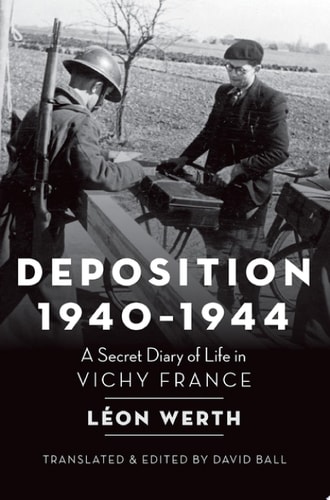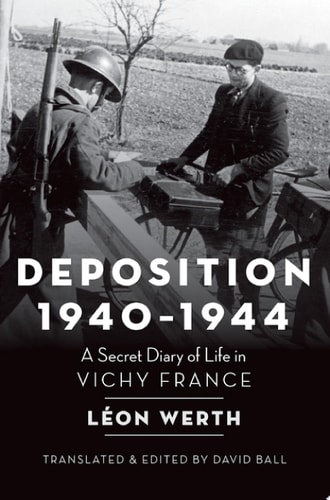
Deposition: 1940-1944
0
0
As an Amazon Associate and affiliate partner, Menrva Books earns from qualifying purchases. Learn more
Author Description
Historians agree: the diary of Léon Werth (1878-1955) is one of the most precious--and readable--pieces of testimony ever written about life in France under Nazi occupation and the Vichy regime. Werth was a free-spirited and unclassifiable writer. He is the author of eleven novels, art and dance criticism, acerbic political reporting, and memorable personal essays. He was Jewish, and left Paris in June 1940 to hide out in his wife's country house in Saint-Amour, a small village in the Jura Mountains. His short memoir 33 Days recounts his struggle to get there. Deposition tells of daily life in the village, on nearby farms and towns, and finally back in Paris, where he draws the portrait of a Resistance network in his apartment and writes an eyewitness report of the insurrection that freed the city in August, 1944.From Saint-Amour, we see both the Resistance in the countryside, derailing troop trains, punishing notorious collaborators--and growing repression: arrests, torture, deportation, and executions. Above all, we see how Vichy and the Occupation affect the lives of farmers and villagers and how their often contradictory attitudes evolve from 1940-1944. Werth's ear for dialogue and novelist's gift for creating characters animate the diary: in the markets and in town, we meet real French peasants and shopkeepers, railroad men and the patronne of the café at the station, schoolteachers and gendarmes. They come off the page alive, and the countryside and villages come alive with them.With biting irony, Werth records, almost daily, what Vichy-German propaganda was saying on the radio and in the press. We follow the progress of the war as people did then, day by day. These entries make interesting, often amusing reading, a stark contrast with his gripping entries on the persecution and deportation of the Jews. Deposition is a varied and complex piece of living history, and a pleasure to read.
Menrva's Summary
THE THESIS
How did the daily realities of life in occupied France under the Vichy regime shape the social and political consciousness of its citizens between 1940 and 1944? Léon Werth, a French writer and intellectual, provides a firsthand account of the occupation from his vantage point in the Jura Mountains and later in Paris. Utilizing his skills as a novelist and journalist, Werth documents the evolving attitudes of rural villagers, the mechanics of the Resistance, and the pervasive influence of propaganda. His work serves as a primary source record of the psychological and physical toll of the war on the French population.
THE SCOPE MAP
What You Will Find
- Daily observations of life in the Jura Mountains and Paris during the German occupation.
- Analysis of Vichy and German propaganda disseminated through radio and print media.
- Detailed portraits of diverse social strata, including farmers, shopkeepers, and Resistance members.
- Eyewitness accounts of the 1944 liberation of Paris.
Scope Limits
- The text does not provide a comprehensive military history of the war's strategic movements.
- It focuses primarily on the author's personal experiences and regional observations rather than a global geopolitical analysis.
THE AUTHORITY PERSPECTIVE
Historians and scholars frequently cite this diary as a foundational primary source for understanding the social climate of occupied France. Readers often note the prose is remarkably accessible and vivid, distinguishing it from more clinical or detached historical records.
Page Count:
368
Publication Date:
2018-05-02
Publisher:
Oxford University Press
ISBN-10:
0190499540
ISBN-13:
9780190499549
Memoir
History
France
World War
Diary
Vichy Regime
Community Tags
Similar Books