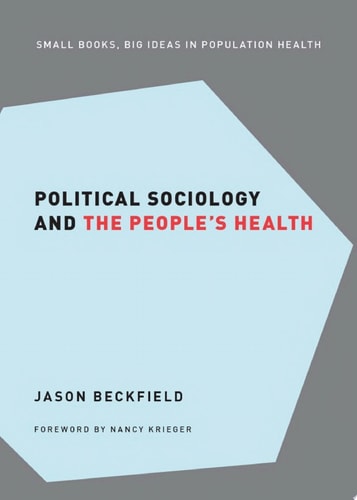
Political Sociology and the People's Health (Small Books Big Ideas in Population Health)
0
0
As an Amazon Associate and affiliate partner, Menrva Books earns from qualifying purchases. Learn more
Author Description
A social epidemiologist looks at health inequalities in terms of the upstream factors that produced them. A political sociologist sees these same inequalities as products of institutions that unequally allocate power and social goods. Neither is wrong -- but can the two talk to one another? In a stirring new synthesis, Political Sociology and the People's Health advances the debate over social inequalities in health by offering a new set of provocative hypotheses around how health is distributed in and across populations. It joins political sociology's macroscopic insights into social policy, labor markets, and the racialized and gendered state with social epidemiology's conceptualizations and measurements of populations, etiologic periods, and distributions. The result is a major leap forward in how we understand the relationships between institutions and inequalities -- and essential reading for those in public health, sociology, and beyond.
Menrva's Summary
THE THESIS
This book investigates how political institutions and social structures fundamentally shape the distribution of health outcomes across populations. Jason Beckfield, a professor of sociology, bridges the gap between social epidemiology and political sociology to argue that health inequalities are not merely individual outcomes but are products of systemic power allocation. He proposes a framework that integrates macroscopic political insights with epidemiological measurements to explain how labor markets, social policies, and state structures influence population health.
THE SCOPE MAP
What You Will Find
- A theoretical framework linking political sociology to social epidemiology
- Analysis of how labor markets and social policies impact health distribution
- Examination of the racialized and gendered nature of state institutions
- New hypotheses regarding the institutional determinants of health
Scope Limits
- The text does not provide clinical medical advice or individual-level health interventions
- It focuses primarily on structural and institutional factors rather than biological or genetic determinants of disease
THE AUTHORITY PERSPECTIVE
Scholars in public health and sociology recognize this work as a bridge between two traditionally siloed disciplines. Readers frequently note the academic density of the prose, which is intended for researchers and students interested in the structural drivers of health disparities.
Page Count:
203
Publication Date:
2018-01-01
Publisher:
Oxford University Press
ISBN-10:
019049249X
ISBN-13:
9780190492496
Population Health
Allied Health
Sociology
Medical
Epidemiology
Public Health
Sociology of Health
Community Tags
Similar Books