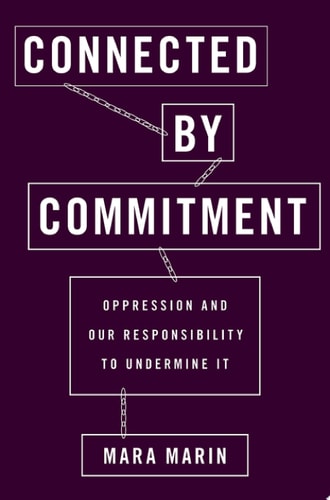
Connected by Commitment
0
0
As an Amazon Associate and affiliate partner, Menrva Books earns from qualifying purchases. Learn more
Author Description
Saying that political and social oppression is a deeply unjust and widespread condition of life is not a terribly controversial statement. Likewise, theorists of justice frequently consider our obligation to not turn a blind eye to oppression. But what is our culpability in the endurance of oppression? In this book, Mara Marin complicates the primary ways in which we make sense of human and political relationships and our obligations within them. Rather than thinking of relationships in terms of our intentions, Marin thinks of them as open-ended and subject to ongoing commitments. Commitments create open-ended expectations and vulnerabilities on the part of others, and therefore also obligations. By this rationale, our actions sustain oppressive or productive structures in virtue of their cumulative effects, not the intentions of the actors. When we violate our obligations we oppress others. Over the chapters of her book, Marin applies her model of commitment to caregivers, marriage, and bargaining power between labor and employers, and examines three types of social relations: political-legal relations, intimate relations of care, and work relations. By linking habitual action to obligation, Marin argues that we should see our responsibilities within such relationships as political and as creating norms for behavior over time. Commitment both points to the support our actions give to oppressive structures and to the ways in which our actions can weaken the same structures. Connected by Commitment examines our obligations to transform structures of oppression and offers commitment as a model for solidarity across race, gender, and class.
Menrva's Summary
THE THESIS
This book investigates the nature of human and political obligations by proposing that our culpability in oppressive structures arises from cumulative habitual actions rather than individual intentions. Mara Marin, a scholar of political theory, challenges traditional frameworks that define relationships through intent. She argues that social and political relationships are defined by open-ended commitments, which create ongoing vulnerabilities and obligations that sustain or challenge systemic oppression.
THE SCOPE MAP
What You Will Find
- A theoretical framework defining social relations as ongoing commitments rather than static agreements.
- Analysis of political-legal relations, intimate caregiving, and labor-employer bargaining power.
- An examination of how habitual actions contribute to the maintenance of structural inequality.
Scope Limits
- The text does not provide a comprehensive history of political philosophy or specific policy prescriptions for legislative reform.
- It focuses primarily on the philosophical mechanics of obligation rather than empirical sociological data collection.
THE AUTHORITY PERSPECTIVE
Scholars in political theory identify this work as a rigorous re-evaluation of how individual agency interacts with systemic power. Readers frequently note the academic density of the prose, which is intended for an audience familiar with contemporary ethical and political discourse.
Page Count:
224
Publication Date:
2017-01-01
Publisher:
Oxford University Press
ISBN-10:
0190498633
ISBN-13:
9780190498634
Political Philosophy
Social Theory
Ethics
Sociology
Community Tags
Similar Books