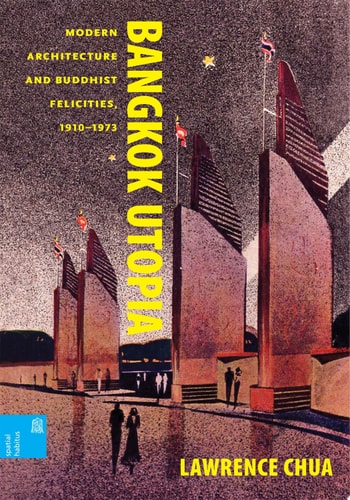
Bangkok Utopia: Modern Architecture and Buddhist Felicities, 1910–1973
0
0
As an Amazon Associate and affiliate partner, Menrva Books earns from qualifying purchases. Learn more
Author Description
“Utopia” is a word not often associated with the city of Bangkok, which is better known for its disorderly sprawl, overburdened roads, and stifling levels of pollution. Yet as early as 1782, when the city was officially founded on the banks of the Chao Phraya river as the home of the Chakri dynasty, its orientation was based on material and rhetorical considerations that alluded to ideal times and spaces. The construction of palaces, monastic complexes, walls, forts, and canals created a defensive network while symbolically locating the terrestrial realm of the king within the Theravada Buddhist cosmos. Into the twentieth century, pictorial, narrative, and built representations of utopia were critical to Bangkok’s transformation into a national capital and commercial entrepôt. But as older representations of the universe encountered modern architecture, building technologies, and urban planning, new images of an ideal society attempted to reconcile urban-based understandings of Buddhist liberation and felicitous states like nirvana with worldly models of political community like the nation-state. Bangkok Utopia outlines an alternative genealogy of both utopia and modernism in a part of the world that has often been overlooked by researchers of both. It examines representations of utopia that developed in the city—as expressed in built forms as well as architectural drawings, building manuals, novels, poetry, and ecclesiastical murals—from its first general strike of migrant laborers in 1910 to the overthrow of the military dictatorship in 1973. Using Thai- and Chinese-language archival sources, the book demonstrates how the new spaces of the city became arenas for modern subject formation, utopian desires, political hegemony, and social unrest, arguing that the modern city was a space of antinomy—one able not only to sustain heterogeneous temporalities, but also to support conflicting world views within the urban landscape. By underscoring t
Menrva's Summary
THE THESIS
This book investigates the complex interplay between modern architectural aspirations and Buddhist ideals of happiness in Bangkok between 1910 and 1973. It explores how the city's founding principles, rooted in Theravada Buddhist cosmology, evolved through the 20th century as modern architecture, building technologies, and urban planning were introduced. The author examines how new images of an ideal society emerged, attempting to reconcile Buddhist concepts of liberation with secular models of the nation-state, using a wide array of sources including architectural drawings, novels, poetry, and ecclesiastical murals.
THE SCOPE MAP
- An examination of utopian representations in Bangkok's built forms and architectural drawings.
- Analysis of building manuals, novels, and poetry as expressions of utopian desires.
- Exploration of ecclesiastical murals and their role in shaping urban ideals.
- Use of Thai
- and Chinese-language archival sources.
- Argument that the modern city was a space of antinomy, sustaining conflicting worldviews.
- Focus on the period from Bangkok's first general strike (1910) to the overthrow of military dictatorship (1973).
THE AUTHORITY PERSPECTIVE
The book is positioned as a significant contribution to the study of urbanism and modernism in Southeast Asia, offering an alternative genealogy of both concepts. It is noted for its interdisciplinary approach, drawing on architectural history, urban studies, and cultural history to analyze Bangkok's development. The work is expected to appeal to scholars and students interested in Asian urbanism, architectural theory, and the intersection of religion and modernity.
Page Count:
296
Publication Date:
2021-02-28
Publisher:
University of Hawaii Press
ISBN-10:
0824884604
ISBN-13:
9780824884604
Architecture
Non-Fiction
History
Asian Studies
urban planning
Community Tags
Similar Books