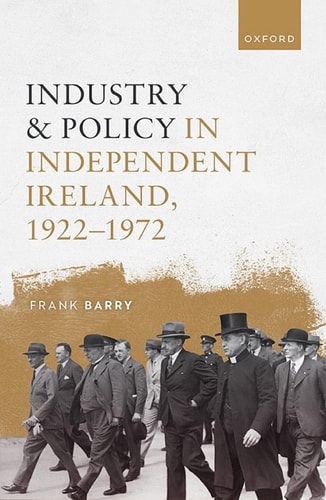
Industry and Policy in Independent Ireland, 1922-1972
0
0
As an Amazon Associate and affiliate partner, Menrva Books earns from qualifying purchases. Learn more
Author Description
This book revisits the history of industry and industrial and economic policy in independent Ireland from the birth of the state to the eve of EEC accession. Though there were several manufacturing employers of significance, and smaller firms in operation in almost every major branch of industry, the Irish Free State was predominantly agricultural at its establishment in 1922. Industrial development was high on the nationalist agenda, as would be the case across the entire developing world in the later post-colonial era. Despite decades of protection, and a substantial increase in the size of the manufacturing sector, Ireland remained under-industrialised when it joined the European Economic Community in 1973. Over the previous decade and a half however the foundations of later convergence had been laid. Ireland was an early adopter of what would come to be known as dual-track reform. The policy of attracting outward-oriented foreign direct investment was initiated before substantial trade liberalisation began. By 1972 there had been a significant diversification in export categories and export destinations, and in the nationality of ownership of the leading manufacturing firms. Some of the most successful indigenous companies of the future were also beginning to emerge. In these and other respects the foundations of the economic progress that would be made over the course of EEC membership were already discernible, notwithstanding the post-accession collapse of most protectionist-era businesses. The analysis is supplemented by a unique firm-level database that allows for the identification of the leading manufacturing firms in operation at any stage from the early 1900s through to 1972. The database extends by more than 50 years the period for which estimates of the significance of foreign-owned industry can be provided.
Menrva's Summary
THE THESIS
This book investigates the complex interplay between industrial development and economic policy in Ireland from its founding in 1922 to its entry into the European Economic Community in 1973. The analysis revisits the nation's journey from a predominantly agricultural state to one grappling with industrialization under decades of protectionist policies. Despite significant growth in the manufacturing sector, Ireland remained under-industrialized by the time of its EEC accession. However, the period also saw the laying of crucial foundations for future economic convergence, including the early adoption of attracting foreign direct investment and a diversification of export markets and ownership structures.
THE SCOPE MAP
- A historical overview of industrial and economic policy in independent Ireland (1922-1972).
- Analysis of Ireland's transition from an agricultural economy to an industrializing one.
- Examination of protectionist policies and their impact on industrial development.
- Discussion of the 'dual-track reform' policy, attracting foreign direct investment before trade liberalization.
- Evidence of export diversification and changes in the nationality of ownership in leading manufacturing firms by 1972.
- Identification of early indigenous companies that would later achieve success.
- A unique firm-level database covering manufacturing firms from the early 1900s to 1972, extending historical data on foreign-owned industry.
THE AUTHORITY PERSPECTIVE
The book offers a detailed historical account of Ireland's industrial and economic policy between 1922 and 1972, focusing on the period leading up to EEC accession. It highlights the challenges of under-industrialization despite protectionist measures and the strategic shifts towards attracting foreign direct investment. The inclusion of a unique firm-level database provides extensive empirical support for its analysis of manufacturing firms and foreign ownership over a significant historical span. The work aims to demonstrate how the foundations for Ireland's later economic progress were established during this formative half-century.
Page Count:
224
Publication Date:
2023-09-07
Publisher:
Oxford University Press Academic UK
ISBN-10:
0198878257
ISBN-13:
9780198878254
Non-Fiction
History
Economics
Business
Community Tags
Similar Books














