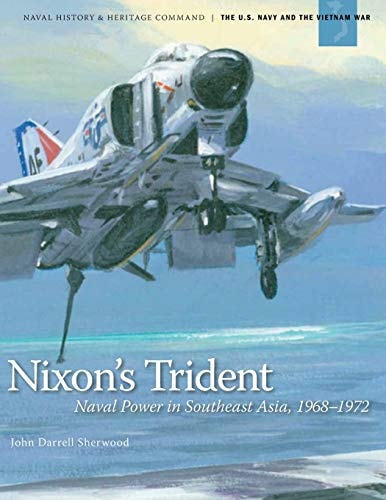
Nixon's Trident Naval Power in Southeast Asia, 1968-1972
0
0
As an Amazon Associate and affiliate partner, Menrva Books earns from qualifying purchases. Learn more
Author Description
This commemoration booklet focuses on naval air power during the final years of the Vietnam War. For much of this period, Navy aircraft sought to hamper the flow of supplies down the Ho Chi Minh Trail in Laos--a huge investment in air power resources that ultimately proved fruitless. After North Vietnam's invasion of the South in 1972, however, Navy tactical aviation, as well as naval gunfire support, proved critical, not only in blunting the offensive but also in persuading North Vietnam to arrive at a peace agreement in Paris in1973. The Navy's forward presence saved the day in 1972 and allowed President Nixon to finally achieve "peace with honor."
Menrva's Summary
THE THESIS
The book examines the critical role of U.S. naval air power in Southeast Asia during the concluding years of the Vietnam War. It details the significant investment in naval aviation aimed at disrupting the Ho Chi Minh Trail, an effort that ultimately yielded limited results. However, following North Vietnam's 1972 offensive, naval tactical aviation and gunfire support became instrumental in repelling the invasion and facilitating peace negotiations. The forward presence of the Navy in 1972 was pivotal in achieving President Nixon's objective of "peace with honor."
THE SCOPE MAP
- Focus on naval air power during the final years of the Vietnam War (1968-1972).
- Analysis of efforts to impede supply flow down the Ho Chi Minh Trail.
- Evaluation of the effectiveness of naval air power resources.
- The critical role of naval aviation and gunfire support in blunting the 1972 North Vietnamese invasion.
- The impact of naval presence on the Paris Peace Accords of 1973.
- President Nixon's strategy of "peace with honor" in relation to naval actions.
THE AUTHORITY PERSPECTIVE
This work is presented as a commemoration booklet focusing on a specific period of naval history. The description highlights the strategic importance and operational details of naval air power during the latter stages of the Vietnam War. It emphasizes the shift in the effectiveness of naval assets from supply interdiction to direct combat support, ultimately contributing to diplomatic outcomes. The narrative frames these events within the context of President Nixon's foreign policy objectives.
Page Count:
86
Publication Date:
2009-07-01
Publisher:
Military Studies Press
ISBN-10:
1782663509
ISBN-13:
9781782663508
History
Non-Fiction
Southeast Asia
Naval history
Military History
Vietnam War
Community Tags
Similar Books