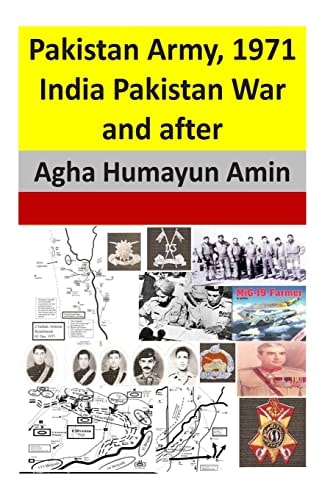
Pakistan Army, 1971 India Pakistan War and After
0
0
As an Amazon Associate and affiliate partner, Menrva Books earns from qualifying purchases. Learn more
Author Description
The strategic concept of Pakistan's defence i.e. 'Defence of East Pakistan lies in the West' was formulated by Ayub Khan in late fifties and became the foundation of Pakistan's defence policy. The concept envisaged having bulk of the army in the northern half of the West Wing and was based on the assumption that this arrangement would force India to keep bulk of its army/strategic reserves on its western front. We will analyse the various aspects of this concept as following: - ALPHA: --The interconnection between the internal and external fronts. The basis of defence and stability of a country is absolute harmony and in consonance with the internal and external fronts. The internal front means 'morale of the civilian population' 'their belief in the legitimacy and moral credibility of the political government' 'belief in national aims and ideology of the country' 'identification with the Armed Forces of the country as defenders of the country's integrity' etc etc. External front includes the country's Armed Forces, and its foreign policy. A country's defence is based on both and any weakness in one will weaken the other. This inter-relationship was ignored by Pakistan's civilian and military leadership during the period 1947-71. The Muslim League was initially dominated by a partnership of refugees from Muslim minority provinces and later by a combination of Punjabi Muslims and civil-military bureaucrats. The Bengalis were alienated first because of the National language issue and later because of the constitutional representation issue. The Bengalis were initially patriotic and only demanded linguistic equality and had even agreed to political parity in 1956. This arrangement was seriously disturbed once Ayub usurped political power in 1958. Immediately after independence the founder of the nation Mr Jinnah made an attempt to broaden the army's recruitment base by ordering the raising of the East Bengal Regiment in 1948
Menrva's Summary
THE THESIS
This book investigates the strategic concept of Pakistan's defense, specifically the notion that 'The defense of East Pakistan lies in the West,' as formulated by Ayub Khan and its implications for the 1971 India-Pakistan War. It analyzes the interconnectedness of a nation's internal and external fronts, arguing that Pakistan's leadership between 1947 and 1971 failed to maintain harmony between the civilian population's morale and the armed forces' capabilities. The author, Agha Humayun Amin, examines how the alienation of Bengalis through linguistic and constitutional issues, coupled with the military's political usurpation, undermined national stability and defense policy.
THE SCOPE MAP
- Analysis of Ayub Khan's 'Defence of East Pakistan lies in the West' strategic concept.
- Examination of the interconnection between Pakistan's internal and external fronts (civilian morale vs. armed forces).
- Discussion of Bengali alienation due to linguistic and constitutional issues.
- Exploration of the impact of Ayub Khan's military rule on national stability and defense policy.
- Consideration of the army's recruitment base and the raising of the East Bengal Regiment.
THE AUTHORITY PERSPECTIVE
The book critically examines Pakistan's defense policy leading up to the 1971 war, focusing on the strategic disconnect between East and West Pakistan. It highlights the author's perspective on the failure of civilian and military leadership to address internal political and social factors that weakened the nation's overall defense posture. The analysis suggests that a lack of national cohesion and the marginalization of Bengali identity were critical flaws in Pakistan's strategic planning. The work aims to provide a deeper understanding of the historical and political underpinnings of the conflict.
Page Count:
478
Publication Date:
2012-10-13
Publisher:
CreateSpace Independent Publishing Platform
ISBN-10:
1480109770
ISBN-13:
9781480109773
History
Non-Fiction
Military History
Community Tags
Similar Books