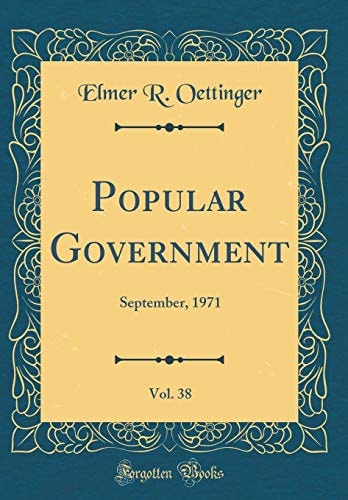
Popular Government, Vol. 38 September, 1971 (Classic Reprint)
0
0
As an Amazon Associate and affiliate partner, Menrva Books earns from qualifying purchases. Learn more
Author Description
Excerpt from Popular Government, Vol. 38: September, 1971 The General Assembly resolved to do the job itself and not leave it to the courts, to do it by hand, and to do it in such fashion as to avoid a successful court challenge to its handiwork. The Supreme Court's decision in Whitcomb v. Chavis, 39. 4666 (1971) when it finally came on June 7, did not rule out multi member districts, thus permitting North Carolina to continue its traditional mixed pattern of single and multi-member districts for both houses. The remainder of this article summarizes the procedures em ployed in preparing the three representation plans enacted by the 1971 session and compares the statistics of the existing and new plans. About the Publisher Forgotten Books publishes hundreds of thousands of rare and classic books. Find more at www.forgottenbooks.com This book is a reproduction of an important historical work. Forgotten Books uses state-of-the-art technology to digitally reconstruct the work, preserving the original format whilst repairing imperfections present in the aged copy. In rare cases, an imperfection in the original, such as a blemish or missing page, may be replicated in our edition. We do, however, repair the vast majority of imperfections successfully; any imperfections that remain are intentionally left to preserve the state of such historical works.
Menrva's Summary
THE THESIS
The General Assembly of North Carolina navigates a complex legal landscape to redraw legislative districts following a Supreme Court decision. The article details the procedures undertaken by the General Assembly to create three new representation plans, aiming to satisfy legal requirements and avoid court challenges. It specifically addresses the implications of the Supreme Court's ruling in Whitcomb v. Chavis, which allowed for the continuation of mixed single and multi-member districts. The text compares the statistical outcomes of the newly enacted plans against the existing district configurations.
THE SCOPE MAP
- Analysis of the General Assembly's legislative redistricting process in North Carolina.
- Discussion of the legal context, including the Supreme Court's decision in Whitcomb v. Chavis (1971).
- Explanation of procedures used to prepare representation plans.
- Comparison of statistical data between existing and new legislative districts.
- Focus on North Carolina's mixed pattern of single and multi-member districts.
THE AUTHORITY PERSPECTIVE
This excerpt from Popular Government, Vol. 38, September 1971, focuses on the procedural and legal aspects of legislative redistricting in North Carolina. The content suggests a detailed, analytical approach to governmental and legal processes, likely aimed at scholars, legal professionals, or those interested in political science and history. The publication by Forgotten Books indicates a focus on preserving historical documents, making this piece valuable for understanding past legislative practices and their legal underpinnings.
Page Count:
84
Publication Date:
2017-10-31
Publisher:
FB&C Limited
ISBN-10:
0260006343
ISBN-13:
9780260006349
History
Non-Fiction
Law
Government
Community Tags
Similar Books