Author Description
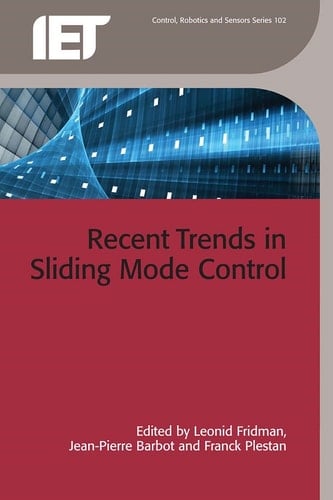
<p>In control theory, sliding mode control, or SMC, is a nonlinear control method that alters the dynamics of a nonlinear system by application of a discontinuous control signal that forces the system to 'slide' along a cross-section of the system's normal behaviour. This book describes recent advances in the theory, properties, methods and applications of SMC.<br></p><p>The book is organised into four parts. The first part is devoted to the design of higher-order sliding-mode controllers, with specific designs presented in the context of disturbance rejection by means of observation and identification. The second part offers a set of tools for establishing different dynamic properties of systems with discontinuous right-hand sides. Time discretization is addressed in the third part. First-order sliding modes are discretized using an implicit scheme - higher-order sliding-mode differentiators, typically used in output-feedback schemes, are discretized in such a way that the optimal accuracy of their continuous-time counterparts is restored.<br></p><p>The last part is dedicated to applications. In the context of energy conversion, sliding-mode control is applied to variable-speed wind turbines, fuel cell coupled to a power converter, rugged DC series motors and rectifiers with unity power factor, and electropneumatic actuator. Finally, an event-triggered sliding-mode scheme is proposed for networked control systems subject to packet loss, jitter and delayed transmissions.<br></p>
Page Count:
440
Publication Date:
2016-01-01
ISBN-10:
1785610775
ISBN-13:
9781785610776