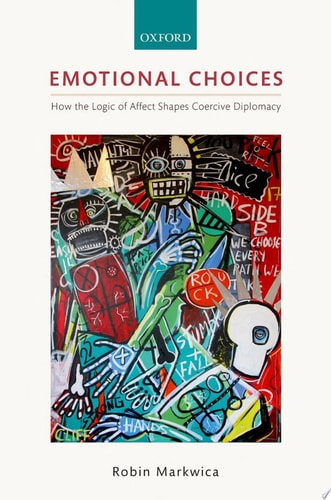
Emotional Choices
0
0
As an Amazon Associate and affiliate partner, Menrva Books earns from qualifying purchases. Learn more
Author Description
Why do states often refuse to yield to military threats from a more powerful actor, such as the United States? Why do they frequently prefer war to compliance? International Relations scholars generally employ the rational choice logic of consequences or the constructivist logic of appropriateness to explain this puzzling behavior. Max Weber, however, suggested a third logic of choice in his magnum opus Economy and Society: human decision making can also be motivated by emotions. Drawing on Weber and more recent scholarship in sociology and psychology, Robin Markwica introduces the logic of affect, or emotional choice theory, into the field of International Relations. The logic of affect posits that actors' behavior is shaped by the dynamic interplay among their norms, identities, and five key emotions: fear, anger, hope, pride, and humiliation. Markwica puts forward a series of propositions that specify the affective conditions under which leaders are likely to accept or reject a coercer's demands. To infer emotions and to examine their influence on decision making, he develops a methodological strategy combining sentiment analysis and an interpretive form of process tracing. He then applies the logic of affect to Nikita Khrushchev's behavior during the Cuban missile crisis in 1962 and Saddam Hussein's decision making in the Gulf conflict in 1990-1 offering a novel explanation for why U.S. coercive diplomacy succeeded in one case but not in the other.
Menrva's Summary
THE THESIS
This book investigates why states frequently reject coercive demands from more powerful actors by introducing the logic of affect as a primary driver of decision-making. Robin Markwica, an expert in international relations, challenges the traditional reliance on rational choice and constructivist frameworks. By synthesizing sociological and psychological research, he argues that emotions—specifically fear, anger, hope, pride, and humiliation—fundamentally shape the strategic calculations of political leaders.
THE SCOPE MAP
What You Will Find
- A theoretical framework for the logic of affect in international politics
- Methodological strategies including sentiment analysis and interpretive process tracing
- Comparative case studies of the 1962 Cuban Missile Crisis and the 1990 Gulf Conflict
Scope Limits
- The analysis is restricted to the specific emotional states of fear, anger, hope, pride, and humiliation
- The study focuses primarily on the decision-making processes of Khrushchev and Hussein rather than broader systemic geopolitical factors
THE AUTHORITY PERSPECTIVE
Scholars in the field of international relations recognize this work as a significant contribution to the integration of psychology into political analysis. Readers frequently note the academic density of the prose and the rigorous application of the author's methodological framework to historical case studies.
Page Count:
400
Publication Date:
2018-01-01
Publisher:
Oxford University Press
ISBN-10:
0192513117
ISBN-13:
9780192513113
Political Psychology
Conflict Studies
International relations
Diplomacy
Community Tags
Similar Books