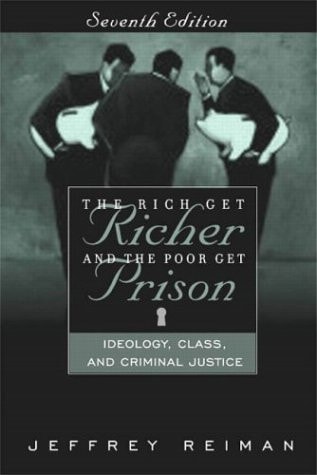
The Rich Get Richer and the Poor Get Prison: Ideology, Class, and Criminal Justice
0
0
As an Amazon Associate and affiliate partner, Menrva Books earns from qualifying purchases. Learn more
Author Description
What if our criminal justice system is biased against the poor from start to finish - from the definition of what constitutes a crime through the process of arrest, trial, and sentencing?The author argues that actions of well-off people—refusal to make workplaces safe, refusal to curtail deadly pollution, promotion of unnecessary surgery, prescription of unnecessary drugs, etc.—cause occupational and environmental hazards to innocent members of the public and produce as much death, destruction, and financial loss as so-called crimes of the poor. However, these crimes of the well-off are rarely treated as severely as those of the poor. Reiman documents the extent of anti-poor bias in arrest, conviction, and sentencing practices and shows that the bias is conjoined with a general refusal to remedy the causes of crime—poverty, poor education, and discrimination. As a result, the criminal justice system fails to reduce crime. The author uses numerous studies and examples to illustrate his points, and difficult concepts are explained in a non-technical manner. The book provokes thought and discussion, even among people who disagree with its content.
Menrva's Summary
THE THESIS
Does the American criminal justice system function as a mechanism that systematically protects the wealthy while disproportionately punishing the poor? Jeffrey Reiman, a professor of philosophy, utilizes extensive sociological data and legal analysis to argue that the system is not designed to eliminate crime, but rather to maintain a specific social order. He posits that the definition of crime is ideologically constructed to focus on street-level offenses while ignoring the systemic harm caused by corporate and white-collar negligence. By examining the disparity in sentencing and enforcement, Reiman demonstrates how the current framework perpetuates poverty and social instability.
THE SCOPE MAP
What You Will Find
- Analysis of the ideological construction of crime definitions in the United States.
- Comparative data on the societal costs of street crime versus corporate and occupational hazards.
- Examination of systemic biases within the arrest, trial, and sentencing phases of the legal process.
- Discussion on the failure of the justice system to address root causes such as poverty and lack of education.
THE AUTHORITY PERSPECTIVE
This text is widely regarded as a foundational critique in the field of critical criminology, frequently utilized in academic settings to challenge conventional views on law enforcement. The work is noted for its accessible prose and its ability to provoke rigorous debate regarding the intersection of class, power, and justice.
Page Count:
256
Publication Date:
2003-07-18
Publisher:
Allyn & Bacon
ISBN-10:
0205386644
ISBN-13:
9780205386642
Criminology
Sociology
Administration of Justice
Community Tags
Similar Books