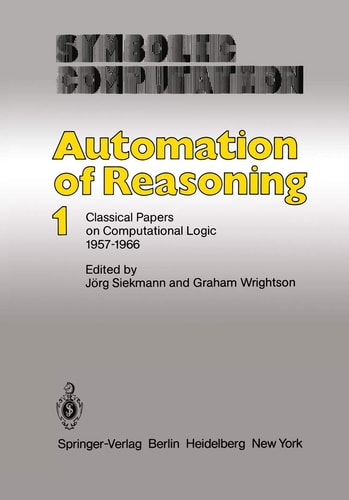
Automation of Reasoning: Classical Papers on Computational Logic 1957–1966
0
0
As an Amazon Associate and affiliate partner, Menrva Books earns from qualifying purchases. Learn more
Author Description
"Kind of Cl'Ude ~ but it UJorks~ boy~ it UJOrksl" Alan Ner. ueH to Herb Simon~ C1rl'istmas 1955 In 1954 a computer program produced what appears to be the first computer generated mathematical proof: Written by M. Davis at the Institute of Advanced Studies, USA, it proved a number theoretic theorem in Presburger Arithmetic. Christmas 1955 heralded a computer program which generated the first proofs of some propositions of Principia Mathematica, developed by A. Newell, J. Shaw, and H. Simon at RAND Corporation, USA. In Sweden, H. Prawitz, D. Prawitz, and N. Voghera produced the first general program for the full first order predicate calculus to prove mathematical theorems; their computer proofs were obtained around 1957 and 1958, about the same time that H. Gelernter finished a computer program to prove simple high school geometry theorems. Since the field of computational logic (or automated theorem proving) is emerging from the ivory tower of academic research into real world applications, asserting also a definite place in many university curricula, we feel the time has come to examine and evaluate its history. The article by Martin Davis in the first of this series of volumes traces the most influential ideas back to the 'prehistory' of early logical thought showing how these ideas influenced the underlying concepts of most early automatic theorem proving programs.
Menrva's Summary
THE THESIS
This collection examines the foundational papers in the field of automated theorem proving and computational logic from its nascent stages in the mid-20th century. The book traces the historical development of key ideas, from early computer programs proving mathematical theorems in Presburger Arithmetic and Principia Mathematica to general-purpose theorem provers for first-order predicate calculus and geometry theorem proving. It aims to provide an evaluation of this history as the field transitions from academic research to practical applications and educational curricula.
THE SCOPE MAP
- Key papers from 1957-1966 in computational logic and automated theorem proving.
- Historical overview of early computer-generated mathematical proofs.
- Discussion of programs proving theorems in Presburger Arithmetic, Principia Mathematica, and geometry.
- Exploration of the development of general programs for first-order predicate calculus.
- Analysis of the field's transition from academic research to real-world applications and curricula.
THE AUTHORITY PERSPECTIVE
This volume serves as a historical survey of the early, critical developments in automated reasoning and computational logic. It compiles seminal papers that laid the groundwork for modern artificial intelligence and formal verification. The collection is valuable for understanding the origins of these fields and the foundational challenges that were addressed.
Page Count:
528
Publication Date:
1983-04-01
Publisher:
Springer Berlin Heidelberg
ISBN-10:
3540120432
ISBN-13:
9783540120438
History
Science & Technology
Non-Fiction
Mathematics
Computer Science
Logic
Community Tags
Similar Books