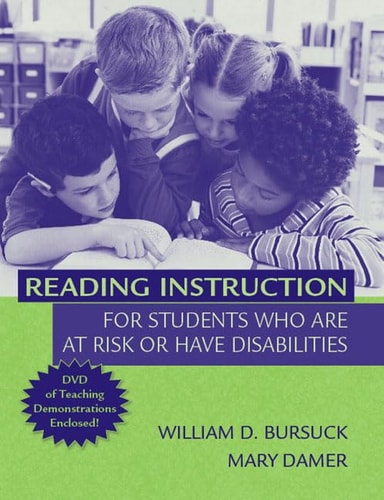
Reading Instruction for Students Who Are at Risk or Have Disabilities
0
0
As an Amazon Associate and affiliate partner, Menrva Books earns from qualifying purchases. Learn more
Author Description
Organized according to the Reading First categories of reading development and instruction as presented in the report of the National Reading Panel, this exciting and timely new text presents teaching strategies for children at-risk, including children of poverty, children for whom English is not their primary language, and children with learning and behavioral disabilities. These are the children No Child Left Behind challenges teachers to serve more effectively.The book is more than a list of teaching strategies that are scientifically-validated; the scientifically-validated practices included are integrated into a systematic teaching process that stresses the use of student outcome data within authentic classroom contexts to guide practice. The teaching strategies have been field tested with at-risk children in both rural and urban teaching settings. Most of the strategies have resulted from work the authors did in their recent four-year federally-funded model-demonstration grant in which they have implemented an extensive reading problem prevention model in grades K-3 in three inner-city schools. Thus, the teaching strategies in the book are ones that the authors implemented every day with at-risk children, not just findings from research articles.Features of this First Edition Include: Content organized around the five components validated by the National Reading Panel: phonemic awareness, phonics, fluency, vocabulary, and comprehension. Readers learn how to use DIBELS and other curriculum-based assessment results for early identification of children at risk of reading failure and to monitor student progress. A unique feature is using DIBELS assessments to pinpoint student skill development as they acquire alphabetic principle. Accompanying DVD shows teacher explicitly teaching letter sound recognition, regular word decoding, sight words, multisyllable word reading, passage reading, vocabulary, and comprehension. Text explains how to use Differentiated Instruct
Menrva's Summary
THE THESIS
This text investigates how educators can effectively implement scientifically-validated reading instruction to improve outcomes for students at risk of failure or those with learning and behavioral disabilities. The authors, Mary Damer and William D. Bursuck, leverage their extensive experience from federally-funded model-demonstration grants to bridge the gap between academic research and daily classroom application. By integrating the five core components of reading development with systematic data-driven assessment, the book provides a framework for teachers to tailor instruction to diverse student populations in both urban and rural settings.
THE SCOPE MAP
What You Will Find
- Systematic application of the five National Reading Panel components: phonemic awareness, phonics, fluency, vocabulary, and comprehension.
- Methodologies for using DIBELS and curriculum-based assessments to identify at-risk students and monitor progress.
- Field-tested teaching strategies derived from four-year implementation models in K-3 inner-city schools.
- Practical guidance on differentiated instruction and explicit teaching techniques for letter sound recognition and word decoding.
THE AUTHORITY PERSPECTIVE
The subject matter points to a highly practical, evidence-based resource designed for K-3 educators and specialists working in high-need school environments. The inclusion of field-tested strategies and assessment-driven frameworks suggests a focus on actionable, classroom-ready pedagogy rather than purely theoretical research.
Page Count:
352
Publication Date:
2006-11-24
Publisher:
Allyn & Bacon
ISBN-10:
0205404049
ISBN-13:
9780205404049
Pedagogy
Literacy
Special Education
Education
Teaching Methods
Community Tags
Similar Books