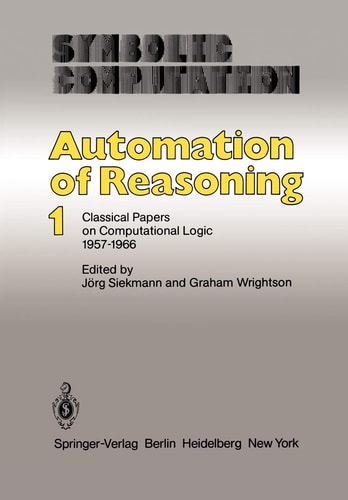
Automation of Reasoning: Classical Papers on Computational Logic 1957–1966
0
0
As an Amazon Associate and affiliate partner, Menrva Books earns from qualifying purchases. Learn more
Author Description
Kind of Cl'Ude ~ but it UJorks~ boy~ it UJOrksl" Alan Ner. ueH to Herb Simon~ C1rl'istmas 1955 In 1954 a computer program produced what appears to be the first computer generated mathematical proof: Written by M. Davis at the Institute of Advanced Studies, USA, it proved a number theoretic theorem in Presburger Arithmetic. Christmas 1955 heralded a computer program which generated the first proofs of some propositions of Principia Mathematica, developed by A. Newell, J. Shaw, and H. Simon at RAND Corporation, USA. In Sweden, H. Prawitz, D. Prawitz, and N. Voghera produced the first general program for the full first order predicate calculus to prove mathematical theorems; their computer proofs were obtained around 1957 and 1958, about the same time that H. Gelernter finished a computer program to prove simple high school geometry theorems. Since the field of computational logic (or automated theorem proving) is emerging from the ivory tower of academic research into real world applications, asserting also a definite place in many university curricula, we feel the time has come to examine and evaluate its history. The article by Martin Davis in the first of this series of volumes traces the most influential ideas back to the 'prehistory' of early logical thought showing how these ideas influenced the underlying concepts of most early automatic theorem proving programs.
Menrva's Summary
THE THESIS
This collection examines the foundational period of automated theorem proving and computational logic. The book compiles seminal papers from 1957 to 1966, tracing the early development of algorithms and programs designed to prove mathematical theorems. It highlights key contributions from researchers like Martin Davis, Newell, Shaw, and Simon, and Prawitz, showcasing their pioneering work in areas such as Presburger Arithmetic, Principia Mathematica, first-order predicate calculus, and geometry theorem proving. The collection serves as a historical record of the field's emergence from theoretical research into practical applications and academic curricula.
THE SCOPE MAP
- Key papers on the automation of mathematical reasoning from 1957-1966.
- Early developments in computational logic and automated theorem proving.
- Contributions from pioneers like Martin Davis, Newell, Shaw, Simon, and Prawitz.
- Historical context of the field's emergence and its impact on curricula.
THE AUTHORITY PERSPECTIVE
This collection is presented as a historical examination of the early years of computational logic. The provided description emphasizes the foundational nature of the included papers and their significance in the development of automated theorem proving. The framing suggests a work intended for academics, historians of science, and researchers interested in the origins of artificial intelligence and formal reasoning systems. The collection aims to provide insight into the seminal ideas that shaped the field.
Page Count:
528
Publication Date:
2012-01-10
Publisher:
Springer Berlin Heidelberg
ISBN-10:
3642819540
ISBN-13:
9783642819544
History
Science & Technology
Non-Fiction
Logic
Computer Science
Community Tags
Similar Books