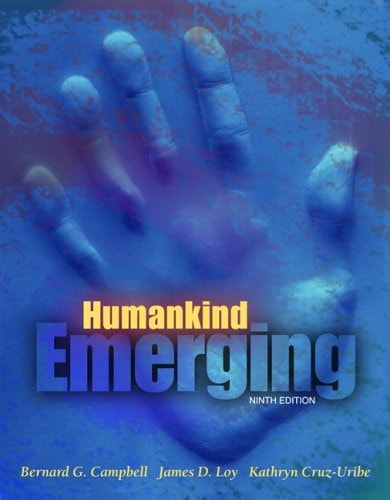
Humankind Emerging
0
0
As an Amazon Associate and affiliate partner, Menrva Books earns from qualifying purchases. Learn more
Author Description
The most comprehensive, up-to-date, and readable introduction to the field of human evolution.The ninth edition of Humankind Emerging tells the story of how, when, and why the human lineage developed from ape-grade ancestors. In Part I, Chapters 1 and 2 present a short history of the rise of evolutionary theory and the science of genetics, followed by a description of the various mechanisms that produce evolutionary change. In Part II, Chapters 3-5put humans in their proper context among the primates, first discussing those aspects of modern primate behavior that help to interpret human prehistory and then describing the fossil evidence for the early stages of primate evolution. In Part III,Chapters 6 and 7 describe the australopiths–members of the subtribe Australopithecina and the first representatives of humans’ zoological tribe, Hominini. Part IV consists of nine chapters that detail the anatomical, cognitive, and behavioral evolution of the genus Homo and its various premodern and modern species. Here the second hominin subdivision–the subtribe Hominina–is described and interpreted. The book ends with Part V in which Chapter 17 discusses modern human diversity, the question of biological races of humans, and the challenges facing humanity in the future.The current edition provides an absolutely up-to-date survey of the hominin fossil species including descriptions of the oldest members of the tribe–Sahelanthropus, Orrorin, and Ardipithecus kadabba (Chapters 6 and 7)–as well as the recently discovered dwarfed species from Indonesia, Homo floresiensis (expanded post-script in Chapter 15). Updates of the taxonomic scheme for the human lineage bring the text into agreement with current paleoanthropological usage. Australopiths are assigned to the subtribe Australopithecina, species of the genus Homo are placed in the subtribe Hominina, and the two subtribes are combined to form the tribe Hominini. Great apes and hominins now are combined in the family Hominidae. Th
Menrva's Summary
THE THESIS
This text investigates the biological and behavioral trajectory of the human lineage, seeking to explain how, when, and why humans evolved from ancestral primate forms. The authors, Bernard G. Campbell, James D. Loy, and Kathryn Cruz-Uribe, synthesize decades of paleoanthropological research, genetic data, and fossil evidence to construct a comprehensive narrative of hominin development. By organizing the material into a structured chronological and taxonomic framework, the book provides a systematic overview of the mechanisms driving evolutionary change and the emergence of modern human diversity.
THE SCOPE MAP
What You Will Find
- A detailed examination of the transition from ape-grade ancestors to the genus Homo.
- Taxonomic classifications of the tribe Hominini, including the subtribes Australopithecina and Hominina.
- Analysis of fossil evidence for early primate evolution and specific hominin species like Sahelanthropus and Homo floresiensis.
- Discussion of modern human biological diversity and the scientific perspective on human races.
THE AUTHORITY PERSPECTIVE
The subject matter points to a dense, academic survey intended for students and researchers seeking a foundational understanding of human evolution. The framing suggests a rigorous, evidence-based approach that prioritizes current taxonomic standards and paleoanthropological consensus.
Page Count:
560
Publication Date:
2005-08-11
Publisher:
Pearson
ISBN-10:
0205423809
ISBN-13:
9780205423804
Science
Evolutionary Biology
Paleoanthropology
textbook
Anthropology
Evolution
Community Tags
Similar Books



Reader Comments
Share Your Thoughts
No comments yet. Be the first to share your thoughts!