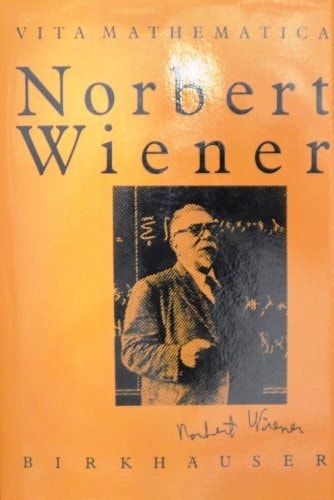
Norbert Wiener, 1894-1964
0
0
As an Amazon Associate and affiliate partner, Menrva Books earns from qualifying purchases. Learn more
Author Description
Norbert Wiener was an American mathematician and philosopher. He was a professor of mathematics at the Massachusetts Institute of Technology (MIT). A child prodigy, Wiener later became an early researcher in stochastic and mathematical noise processes, contributing work relevant to electronic engineering, electronic communication, and control systems. Wiener is considered the originator of cybernetics, a formalization of the notion of feedback, with implications for engineering, systems control, computer science, biology, neuroscience, philosophy, and the organization of society. Wiener thought on a grand scale and stressed the adaptation of technical concepts from pure mathematics and electrical engineering outside their technical contexts. Masani's interesting and thoughtful book analyses both Wiener's mathematical and his nonmathematical ideas in sympathetic and sensitive detail. Readers will find much to appreciate in this book, in addition to the discussion of Wiener's technical research.
Menrva's Summary
THE THESIS
Norbert Wiener's life and work are examined, from his early prodigy status to his foundational contributions to cybernetics. This biography delves into the multifaceted career of Norbert Wiener, an American mathematician and philosopher who significantly impacted fields ranging from engineering to societal organization. As a professor at MIT, Wiener pioneered research in stochastic processes and is credited as the originator of cybernetics, a concept central to feedback systems. The book analyzes both his technical mathematical ideas and his broader philosophical concepts, highlighting his unique ability to adapt abstract principles to diverse contexts.
THE SCOPE MAP
- Biographical details of Norbert Wiener's life, from childhood prodigy to MIT professor.
- Analysis of Wiener's pioneering work in stochastic and mathematical noise processes.
- Exploration of Wiener's role as the originator of cybernetics and the concept of feedback.
- Discussion of cybernetics' implications across various disciplines: engineering, computer science, biology, neuroscience, philosophy, and social organization.
- Examination of Wiener's adaptation of technical concepts from mathematics and electrical engineering to non-technical contexts.
- Insight into Wiener's philosophical ideas and their connection to his scientific work.
- Appreciation of Wiener's broad thinking and his ability to connect disparate fields.
THE AUTHORITY PERSPECTIVE
Masani's biography is noted for its thoughtful and sympathetic analysis of Norbert Wiener's complex intellectual contributions. The book is appreciated for detailing both Wiener's significant technical research in mathematics and cybernetics, as well as his broader philosophical ideas. Readers are expected to find value in the sensitive exploration of his work, which extends beyond his purely scientific achievements. The author's approach highlights Wiener's unique perspective on adapting abstract concepts to a wide array of fields.
Page Count:
416
Publication Date:
1990-01-01
Publisher:
Springer
ISBN-10:
0817622462
ISBN-13:
9780817622466
History
Non-Fiction
Science
Biography
Community Tags
Similar Books














