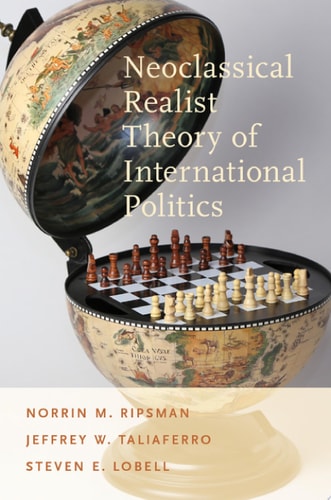
Neoclassical Realist Theory of International Politics
0
0
As an Amazon Associate and affiliate partner, Menrva Books earns from qualifying purchases. Learn more
Author Description
Since Gideon Rose's 1998 review article in the journal World Politics and especially following the release of Lobell, Ripsman, and Taliaferro's 2009 edited volume Neoclassical Realism, the State, and Foreign Policy, neoclassical realism has emerged as major theoretical approach to the study of foreign policy on both sides of the Atlantic. Proponents of neoclassical realism claim that it is the logical extension of the Kenneth Waltz's structural realism into the realm of foreign policy. In Neoclassical Realist Theory of International Relations, Norrin M. Ripsman, Jeffrey W. Taliaferro, and Steven E. Lobell argue that neoclassical realism is far more than an extension of Waltz's structural realism or an effort to update the classical realism of Hans Morgenthau, E.H. Carr, and Henry Kissinger with the language of modern social science. Rejecting the artificial distinction that Waltz draws between theories of international politics and theories of foreign policy, the authors contend neoclassical realism can explain and predict phenomena ranging from short-term crisis-behavior, to foreign policy, to patterns of grand strategic adjustment by individual states up to long-term patterns of international outcomes. It is, therefore, a more powerful theory of international politics than structural realism. Yet it is also a more intuitively satisfying approach than liberal Innenpolitik theories or constructivism. The authors detail the variables and assumptions of neoclassical realist theory, address various aspects of theory construction and methodology, lay out the areas of convergence and sharp disagreement with other leading theoretical approaches -- liberalism, constructivism, analytic eclecticism, and foreign policy analysis (FPA) --- and demonstrate how neoclassical realist theory can be used to resolve longstanding puzzles and debates in international relations theory.
Menrva's Summary
THE THESIS
This book investigates whether neoclassical realism serves as a more comprehensive and predictive framework for international politics than existing structural realist or liberal theories. The authors, all established scholars in the field of international relations, synthesize decades of academic discourse to position neoclassical realism as a robust methodology. They argue that by bridging the gap between structural constraints and domestic-level variables, the theory provides a superior explanation for state behavior, ranging from immediate crisis management to long-term grand strategy.
THE SCOPE MAP
What You Will Find
- A detailed breakdown of the variables and assumptions inherent in neoclassical realist theory.
- A comparative analysis of neoclassical realism against liberalism, constructivism, and analytic eclecticism.
- Methodological frameworks for applying the theory to historical and contemporary foreign policy puzzles.
Scope Limits
- The text does not provide a comprehensive history of all realist thought, focusing instead on the specific evolution of the neoclassical branch.
- It does not offer prescriptive policy advice for current world leaders, remaining strictly within the realm of theoretical analysis.
THE AUTHORITY PERSPECTIVE
Scholars and students of international relations frequently identify this work as a definitive text for understanding the maturation of neoclassical realism as a distinct academic discipline. Experts highlight the book's rigorous attempt to reconcile structural constraints with domestic political agency, making it a foundational resource for advanced political science curricula.
Page Count:
208
Publication Date:
2016-01-01
Publisher:
Oxford University Press
ISBN-10:
0190603046
ISBN-13:
9780190603045
Realism
Foreign Policy
International Security
Political Theory
International relations
Community Tags
Other Editions(2)
Similar Books




Reader Comments
Share Your Thoughts
No comments yet. Be the first to share your thoughts!