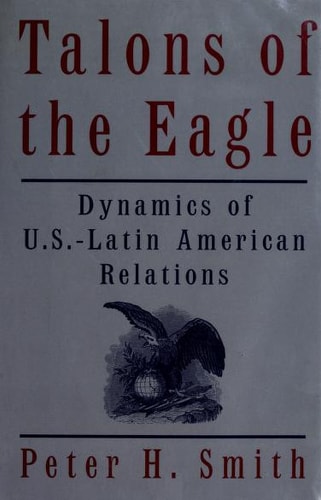
Talons of the Eagle: Dynamics of U.S.-Latin American Relations
0
0
As an Amazon Associate and affiliate partner, Menrva Books earns from qualifying purchases. Learn more
Author Description
Contrary to widespread expectation, the ending of the Cold War has not produced continuous harmony and cooperation in U.S.-Latin American relations. Instead, NAFTA seems to threaten as much as it promises; economic prospects have been shaken by the Mexican currency crisis; the "war on drugs" continues to escalate; and xenophobic reactions to the migration of Latin Americans into the United States, typified by California's Proposition 187, seize headlines and editorial pages.Spanning almost two hundred years, Talons of the Eagle tells the turbulent story of U.S.-Latin American relations from the birth of the United States and the new Latin American nations through the Cold War to the present day. Focusing not on U.S. policy alone, but on the intricate network of relationships between the United States and its neighbors, Peter H. Smith sheds penetrating new light on trends and events in the Americas. Beginning with the balance-of-power politics of the nineteenth century and efforts by the United States to establish its own sphere of influence in the New World, Smith describes the complex interplay between U.S. expansionism and Latin American reactions, which varied from lofty visions of continental unity to vigorous expressions of nationalistic and cultural resistance. Later, during the Cold War, Washington waged unremitting campaigns to eradicate perceived Soviet influence in Latin America, often allying itself with dictators and despots. Covert and overt American operations ranged from numerous attempts to assassinate Fidel Castro to armed intervention in the Dominican Republic and the invasion of Grenada; faced by stark alternatives, many Latin Americans turned toward socialist revolution and/or the pursuit of Third World solidarity. In the aftermath of the Cold War, U.S.-Latin American relations have now become dominated by economic and social questions, from drug trafficking and drug wars to illegal immigration from countries such as Haiti and Mexico.
Menrva's Summary
THE THESIS
This work investigates the complex, often turbulent evolution of diplomatic, economic, and social interactions between the United States and Latin American nations over the past two centuries. Peter H. Smith, a distinguished scholar in Latin American studies, utilizes a comprehensive historical framework to challenge the notion that the post-Cold War era would naturally lead to regional harmony. By analyzing the interplay between U.S. expansionist policies and the diverse responses from Latin American states, the author argues that the relationship is defined by persistent structural tensions rather than simple cooperation.
THE SCOPE MAP
What You Will Find
- A historical analysis spanning from the early nineteenth century to the post-Cold War era.
- Examination of U.S. influence, including Cold War interventionism and modern economic integration.
- Discussion of social issues such as drug trafficking, migration, and cultural resistance.
- A comparative look at the shifting power dynamics between the United States and its southern neighbors.
THE AUTHORITY PERSPECTIVE
Experts and academics frequently cite this text as a foundational resource for understanding the structural history of inter-American relations. Readers often note the clarity of the prose, which manages to synthesize complex geopolitical events into an accessible narrative for both students and policy analysts.
Page Count:
392
Publication Date:
1996-04-18
Publisher:
Oxford University Press
ISBN-10:
0195083032
ISBN-13:
9780195083033
History
Foreign Policy
International relations
United States
Community Tags
Other Editions(2)

Similar Books






Reader Comments
Share Your Thoughts
No comments yet. Be the first to share your thoughts!