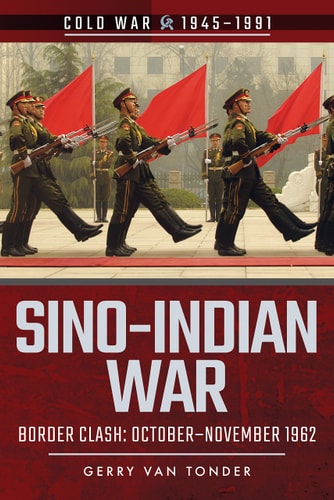
Sino-Indian War Border Clash, October--November 1962
0
0
As an Amazon Associate and affiliate partner, Menrva Books earns from qualifying purchases. Learn more
Author Description
For a hundred years, British and Chinese territorial claims in the Himalayas conflicted, with Indian historians claiming that the region was the fountainhead of Hindu civilization. In the halcyon days of the Raj, London saw Afghanistan and Tibet as buffers against Russian and Chinese imperialism. In 1913, an ephemeral agreement between Britain, Tibet and China was signed, recognizing the McMahon Line as the border of the disputed territory. China, however, failed to ratify the agreement, while India protested against a loss of historical land. After the Second World War, India became independent of Britain and Chinese Communists proclaimed a people's republic. Despite cordial overtures from Indian Prime Minister Nehru, in late 1950 the Chinese People's Liberation Army (PLA) invaded Tibet. In the ensuing twelve years, Indian diplomacy and Chinese 'cartographic aggression' were punctuated by border incidents, particularly in 1953 when armed clashes precipitated a significant increase in the disposition of troops by both sides. In the spring of 1962, Indian forces flooded into the Ladakh region of the state of Jammu and Kashmir, to check the Chinese. In a spiralling game of brinkmanship, in September, ground forces were strategically deployed and redeployed. On 10 October, thirty-three Chinese died in a firefight near Dhola. Embittered by Moscow's support of India against a sister communist state, and in a bid to clip Nehru's belligerent wings, on 20 October, the PLA launched a two-pronged attack against Indian positions.
Menrva's Summary
THE THESIS
The Sino-Indian War of 1962 erupted from a century of escalating territorial disputes and diplomatic tensions in the Himalayas. Following the establishment of the People's Republic of China and India's independence, the unresolved McMahon Line became a flashpoint, exacerbated by Chinese incursions into Tibet and India's strategic responses in regions like Ladakh. The conflict culminated in a full-scale invasion by the People's Liberation Army in October 1962, driven by geopolitical factors including Moscow's alignment with India and a desire to curb India's assertive foreign policy.
THE SCOPE MAP
- An examination of the historical territorial claims by British, Chinese, and Indian entities in the Himalayan region.
- Analysis of the geopolitical strategies of Britain, China, Russia, and India in the context of the Raj and post-WWII era.
- Detailed account of the events leading up to the 1962 war, including border incidents and diplomatic maneuvers.
- Exploration of the significance of the McMahon Line and China's non-ratification of the 1913 agreement.
- Discussion of the impact of the Chinese invasion of Tibet in 1950 and subsequent border skirmishes.
- Focus on the escalating brinkmanship in the spring and autumn of 1962, including troop deployments and specific firefights.
- An analysis of the motivations behind the PLA's two-pronged attack in October 1962.
THE AUTHORITY PERSPECTIVE
The book details the complex historical and geopolitical factors that led to the 1962 Sino-Indian War, focusing on territorial disputes and diplomatic failures. It traces the origins of the conflict from the British Raj era through to the post-World War II period, highlighting key events such as the Chinese invasion of Tibet and escalating border incidents. The narrative builds towards the military confrontation, examining the strategic decisions and international relations that shaped the conflict. The work appears to offer a focused historical account of this significant Cold War-era border war.
Page Count:
127
Publication Date:
2018-01-01
Publisher:
Pen & Sword Books Limited
ISBN-10:
1526728370
ISBN-13:
9781526728371
History
Non-Fiction
Asian History
Military History
Community Tags
Similar Books