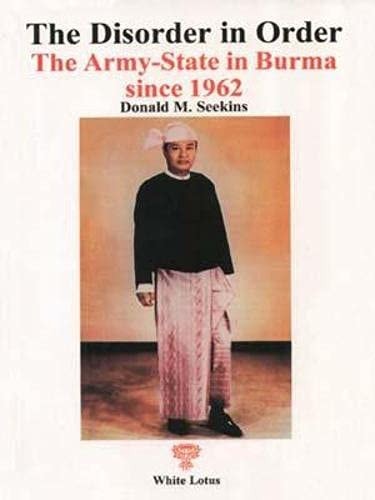
Disorder in Order: Army State in Burma Since 1962
0
0
As an Amazon Associate and affiliate partner, Menrva Books earns from qualifying purchases. Learn more
Author Description
The book examines Burma’s history of “regime entropy” following the March 1962 coup d’état which ended the country’s brief experiment with parliamentary government. Implementing socialist economic policies in central Burma and a hard line against ethnic and communist insurgents in the border areas, Ne Win’s Army-State presided over the country’s fall from prosperity to Least-Developed Nation status by 1987. The following year, a new martial law regime the State Law and Order Restoration Council (SLORC) brutally suppressed a nationwide movement for democracy that drew on the country’s colonial-era traditions of revolutionary nationalism. Although SLORC promoted an open economy, including foreign private investment, the second army-state operates on the same assumptions as its predecessor: that government is synonymous with pacification, unquestioned central control and cultural homogenization. The author argues that while the post-1988 junta, renamed the State Peace and Development Council in November 1997, claims a unique mission in defending national unity and social order, its policies generate political disunity and socioeconomic disorder. Tragically, genuine order, the key to Burma’s development, remains out of reach as the 21st century dawns.
Menrva's Summary
THE THESIS
The book investigates the persistent instability and authoritarian rule in Burma (Myanmar) since the 1962 military coup. Donald M. Seekins analyzes the historical trajectory of Burma's military regimes, tracing the consequences of socialist economic policies and hardline approaches to internal conflict. The author posits that successive army-states, despite claims of maintaining national unity and order, have fundamentally generated political disunity and socioeconomic disorder, hindering the nation's development.
THE SCOPE MAP
- Analysis of Burma's "regime entropy" following the 1962 coup d’état.
- Examination of Ne Win's socialist economic policies and their impact.
- Discussion of the military's approach to ethnic and communist insurgencies.
- Critique of the State Law and Order Restoration Council (SLORC) and its suppression of democracy movements.
- Analysis of the post-1988 junta's (renamed State Peace and Development Council) assumptions regarding government, control, and cultural homogenization.
- Argument that the junta's policies lead to political disunity and socioeconomic disorder, rather than genuine order.
THE AUTHORITY PERSPECTIVE
The book is an analytical examination of Burma's post-1962 political and economic history, focusing on the persistent patterns of military rule and their consequences. The author's argument centers on the concept of "regime entropy" and how successive juntas, despite their stated aims, have perpetuated disorder. The work likely appeals to scholars and students of Southeast Asian politics and history, offering a critical perspective on the challenges to achieving genuine order and development in Burma.
Page Count:
403
Publication Date:
2002-08-01
Publisher:
White Lotus Co., Ltd
ISBN-10:
9747534967
ISBN-13:
9789747534962
Politics
Non-Fiction
History
Asian Studies
Community Tags
Similar Books