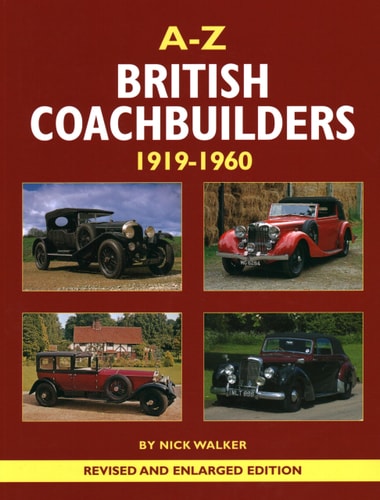
A-Z British Coachbuilders 1919-1960
0
0
As an Amazon Associate and affiliate partner, Menrva Books earns from qualifying purchases. Learn more
Author Description
Coachbuilding on motor car chassis evolved from carriage building, and the development of the coachbuilt body closely followed that of the motor car. From the beginning of the 20th century until the arrival in the late 1930s of unitary construction for motor cars, in which the separate chassis and body gave way to a combined body/chassis structure, coachbuilding flourished in Britain, with hundreds of firms exhibiting their latest designs at motor shows year after year. But by the outbreak of World War 2, the industry was already in terminal decline. Many coachbuilders, like Barker or Hooper built one-off bodies for the `carriage trade', the noble and wealthy who sought the distinction of choosing a style of body and interior to suit their personal tastes and requirements, and such bodies were naturally to be found on the most expensive makes of motor car, like the Rolls-Royce, Bentley and exotic marques from the Continent. Other coachbuilders aimed to produce inexpensive bodies in series for volume manufacturers who wanted, for example, to be able to offer a convertible version of a certain model but did not wish to have to make the bodies themselves. Yet others established a special relationship with a single manufacturer, like Charlesworth with Alvis, in order to procure a steady flow of work. This book is a comprehensive study of coachbuilding, and coachbuilders, in Britain. The author sets the scene by describing advances in fashions and techniques of coachbuilding in separate chapters on the 1920s, 1930s and the postwar period. He then gives a unique A-Z coverage of more than 300 British coachbuilders. In addition, there is a chapter offering useful advice on assessing the condition, and likely repair needs, of a coachbuilt body today. A glossary of coachbuilding terms and what they mean completes the picture. More than 400 photographs, 50 of them in color, have been painstakingly hunted down to illustrate coachbuilding fashions and methods as well as the work
Menrva's Summary
THE THESIS
This book comprehensively studies the evolution and decline of British coachbuilding from 1919 to 1960, a period marked by significant technological and stylistic shifts in the automotive industry. The author, Nick Walker, details the transition from traditional carriage building to specialized motor car bodies, exploring the diverse business models of coachbuilders, from bespoke luxury commissions to series production for volume manufacturers. The work is structured chronologically with chapters on the 1920s, 1930s, and the post-war era, followed by an extensive A-Z directory of over 300 British coachbuilders.
THE SCOPE MAP
- Detailed historical context of coachbuilding's development alongside the motor car.
- Analysis of different coachbuilder business strategies, including bespoke luxury and series production.
- Chronological chapters covering the 1920s, 1930s, and the post-war period.
- An A-Z directory of over 300 British coachbuilders.
- Guidance on assessing the condition and repair needs of vintage coachbuilt bodies.
- A glossary of coachbuilding terms.
- Over 400 photographs, including 50 in color, illustrating fashions and methods.
THE AUTHORITY PERSPECTIVE
The book is a comprehensive study of British coachbuilders, offering unique A-Z coverage of over 300 firms. It is praised for its detailed historical context, including separate chapters on the 1920s, 1930s, and the post-war period, and is further enhanced by over 400 photographs. The inclusion of advice on assessing the condition of coachbuilt bodies today and a glossary of terms makes it a valuable resource for enthusiasts and historians alike.
Page Count:
224
Publication Date:
2007-06-15
Publisher:
Herridge & Sons Limited
ISBN-10:
0954998162
ISBN-13:
9780954998165
History
Non-Fiction
Reference
Automotive History
Industrial history
Community Tags
Similar Books