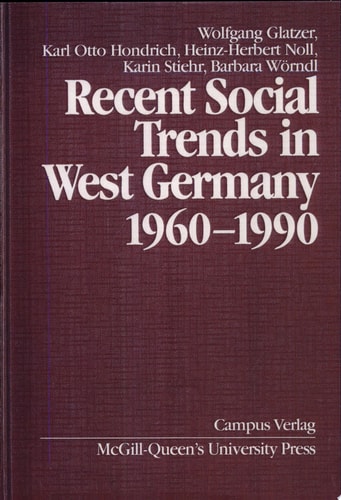
Recent Social Trends in West Germany, 1960-1990
0
0
As an Amazon Associate and affiliate partner, Menrva Books earns from qualifying purchases. Learn more
Author Description
This volume examines social trends in West Germany during the period between 1960 and 1990. This was a special phase of German history: the Federal Republic of Germany was founded in 1949, and by 1960 the main disturbances of the Second World War had been overcome. The next thirty years saw relatively stable development in democratic institutions, economic wealth, and the welfare state. This process, however, was not entirely without difficulties. Environmental conditions deteriorated and unemployment grew, especially in the 1980s. A new, reunified Germany replaced the "old" FRG in 1990, ushering in a fundamentally different social structure.
Menrva's Summary
THE THESIS
This volume investigates the significant social transformations and enduring challenges within West Germany from its post-war recovery to reunification. The period from 1960 to 1990 marked a unique era for the Federal Republic, characterized by the stabilization of democratic institutions, economic prosperity, and the expansion of the welfare state following the devastation of World War II. However, this development was accompanied by increasing environmental degradation and rising unemployment, particularly in the final decade. The book analyzes these dynamics, culminating in the profound societal shifts brought about by German reunification in 1990.
THE SCOPE MAP
- Analysis of social trends in West Germany between 1960 and 1990.
- Examination of the post-war recovery and the establishment of democratic institutions.
- Discussion of economic wealth and the development of the welfare state.
- Investigation into environmental deterioration and rising unemployment, especially in the 1980s.
- Exploration of the social structural changes leading up to and following German reunification in 1990.
- Comparative charting of social change in advanced industrial societies, with a focus on West Germany.
THE AUTHORITY PERSPECTIVE
This scholarly work provides a detailed examination of a pivotal thirty-year period in West German history, offering insights into the complex interplay of social, economic, and political factors. The book's focus on empirical data and historical analysis suggests it is a valuable resource for academics and students specializing in modern German history and European social studies. Its comprehensive scope, covering institutional stability, economic growth, and emerging challenges like environmental issues and unemployment, positions it as a key text for understanding the transition to a reunified Germany. The research group's comparative approach further enhances its contribution to the study of social change in advanced industrial societies.
Page Count:
549
Publication Date:
1992-01-01
Publisher:
McGill-Queen's Press - MQUP
ISBN-10:
3593344025
ISBN-13:
9783593344027
History
Non-Fiction
Politics
Sociology
Social Science
Community Tags
Similar Books